Tuesday, November 20, 2007

feelies


I found these animations on YouTube while looking for dB's related material (see my brief mention of the band below, tenth paragraph). The video for their song "Big Brown Eyes" features animation by Emily Hubley. I like the song quite a bit but the visuals not so much. Further browsing of the nets revealed her to be the daughter of pioneering husband and wife animators Faith and John Hubley. (Her sister is is Yo La Tengo drummer Georgia.) I'm posting some of their stuff because it looks intriguing.

The couple married in 1955 and founded the collaborative Storyboard Studios the same year. As the top video suggests, they too worked with some of the most exiting musicians of their time. See also this entertaining outing with Dizzy Gillespie and cohorts. Faith continued making films after her husband's death in 1977 and the video below is one of these "solo" efforts. I like its synesthetic free-association and the drawing style, which reminds me of the underappreciated Romainian surrealist Victor Brauner (and Miro, more obviously). And yes, I have a taste for whimsy. Faith unfortunately passed away in 2001.

Labels: , , ,

Saturday, November 17, 2007

rise and fall

This past Thursday evening, I attended the Cornell screening of a rough cut of a documentary film by Long Islander Jake Gorst. It is entitled The Rise and Fall of Books and is being planned for PBS. (See Wylie Schwartz's piece in this week's Times.) Its title is somewhat misleading, since the main subject is really Cornell professor Buzz Spectorthe man and artistalong with his recent book installation project, the "Big Red C."

I prefer to think of the "C" as an abstract, monumental arc. (C for Cornell? Or for "community," as someone suggested at the screening? This seems like a contrived jingoism and besides, the piece didn't even feel that much letter-like on-site). The piece was made up of over 800 books, all of them supposedly the work of Cornell humanists
professors, students, or alumni. Shapes and subjects ranged from children's books and coffee-table science books to classics (with new introductions) and ponderous-looking theoretical texts (reference). The shape was like a curved staircase: almost touching the floor on one end, the height of a child on the other.

Spector and a group of students constructed the form in a Cornell-owned building in Chelsea during the second week of January this year. The piece was rebuilt on-campus (using the same bo
oks) for an April exhibition. I saw it then at the Kroch Library and I liked it, despite my unease with some its symbolic aspects. (Disclosure: Buzz has been very friendly to me, which is impressive given our relative statures.)

The film was indeed rough, full of awkwardness that could be resolved by better pacing and arrangement. It centers around footage Gorst had shot with the intention of merely documenting the piece and its initial construction in NYC. But Gorst soon realized that he had the makings of a feature length film and so he went for it. The movie also features Buzz interviewed in his office (at Cornell, I believe) talking about some of his past work and how it related to his biography. These segments could be fleshed out and better integrated. Indeed, Gorst told the seated audience that he plans to do another interview.

Buzz as long worked with books, "both as subject and as object." As well as piling books and photographing them, he has worked extensively in altered books. One piece shown in the film was a book from which pages had been carefully torn
nearly the whole first page was missing, with more and more of the page present as one goes through the book. It seems clear to me at least that this is a man as in love with his medium as any painter.

He spoke movingly of his works relation to his biography (perhaps working against his stereotype has a cold, cerebral artist). He spoke of his mother's disapproval of him making art out of damaged books and how she eventually came around after recalling a childhood incident in which he sat by the waterside arranging stones to trace the lines made by the receding waves. He and she both saw an intimate connection between this and his mature artistic expression.

Although not quite justifying the title, he argues for the continuing value of the printed word in an increasingly digital world. He explains that some forms of printed literature will disappear, for example the phone book. But others, such as novels and books of poetry will prevail. The case is made largely based on a emotional appeal to appreciation for the mate
rial and tactile aspects of reading. There were, however, some suggestions that younger generations might not be as appreciative. A longtime friend of Buzz's (whose name I forget, and who is identified vaguely as a "writer") emphasizes the old-fogginess of this perspective. A child at the opening for the C carries what looks like a hand-held video game.

Buzz is also enchanted by analog photography. He owns an impressive large-format Polaroid camera, which he uses to photograph his installations. In Rise, he compares the materiality of the resulting prints to painting. These he considers art (you would to, if you saw them in the flesh) as opposed to the numerous digital shots, which are mere documentation.

The main focus of Rise however, was Spector and his students in downtown Manhattan. They drive around in a van, unpack boxes, sort and arrange books. There is a time lapse sequence in which the sculpture is put together in a minute or two. There are brief interviews with a handful of students, some of them awkward or annoying, others endearing. Some bits seemed to drag on too long or felt out of place, but again, this is a matter of arrangement. The basic material is strong.

The film features a rocking soundtrack by dB's, which effectively conveys the feeling of being young (or young at heart, to use the cliche) in the big city. Some of the songs were newly written for the project. As Buzz explained after the screening, he had designed early album art for their predecessor group, the Sneakers back in the 70's. Their involvement in the documentary was a lovely coincidence. Unfortunately, the music was less suited for some of the more reflective moments.

As I mentioned in the discussion following the screening, my main difficulty was the exclusion of Cornell University as subject. The sense given by the film was Buzz playing hooky with his students in the big city, which is all well and good as far as it goes. It might come off as square or boring to mention the institutional connection. But it does seem awfully willful to ignore the facts: the project was planned by a Cornell prof (formally the director of the art department, now on leave), executed by Cornell students for credit, built out of Cornell books, and presumably funded by university funds. We see an alumni studded reception at the end of the film. Ostensibly, the piece represents the unity of humanities scholarship at Cornell (I'm not sure that I buy this either though). I can understand how personal artistic goals and connection with students are more interesting and important than all of this. Certainly, non-Cornellians like me and Gorst are most likely to latch on to such aspects. But still, it does seem willful. I spoke with Buzz a bit after the event and he did seem receptive to my comments.

UPDATE (11/19/07): Buzz tells me that he in fact rents the camera (of which only around 15 exist) from the Polaroid 20X24 Studio in New York. Apologies. Also, the "writer" mentioned above is Reagan Upshaw, a New York poet and art dealer.

Labels: , , , , , ,

Sunday, November 11, 2007

links and announcements for a sunday afternoon in november

* Mr. Schjeldahl and Mrs. Smith on the Seurat drawing show at MoMA.

*"The Twelve Devices of Peanuts." (via)


*A hand-drawn map depicting most of the traversable terrain in the classic computer game Zork.

*MIT is suing Frank Gehry. They are alleging negligence in the design of their 300 million dollar Stata Center, which opened back in 2004. (via)

*Mark Steyn on Allan Bloom on rock'n' roll. (via)

*The Great Pumpkin.

*From this weekend's Ithaca Journal: Carol Kammen on blogs as popular history.

*Nancy Geyer on the big video art extravaganza currently taking up most of the Johnson Museum's temporary exhibition space. I need to get up there and see it myself.

*Local artist Jay Hart is showing examples of his "terrain art" at Cornell's Mann Library Gallery. The show will be up through January 10 with a reception taking place this coming Tuesday from 5 to 6 in the evening. I do fetishize aerial perspective in art and there seem to be at least a handful of local artists working (with various levels of abstraction) in this vein. More on this sometime, I think.

*Speaking of which, my hero, the Queens painter Josh Dorman has taken part in a television documentary, There is a Bridge. The show, narrated by Mr. Robert Pinsky, deals with some of the social and humanistic aspects of Alzheimer's disease. From their website:
Josh Dorman, a nationally recognized artist living in New York, came to Alden Town Manor Rehabilitation and Health Care Center in Cicero, Ill., in August 2005 to create five paintings based on the imaginative and emotional landscapes of five people with advanced dementia. Assisted by Michael Verde of Memory Bridge and two social workers from Northwestern University, Josh spent six hours a day with five residents of Alden Town Manor. The thoughts, feelings, memories, dreams, and whatever else residents chose to share with Josh provided him the imaginative material from which he created his paintings. Josh earned a B.A from Skidmore College and an M.F.A. from Queens College.
You can see the paintings here. They incorporate literal portraiture, something I don't thing I've seen before in Dorman's work. (There is an interesting parallel here with some of Barbara Mink's recent work.)

The show is airing on various public tv stations at different times; depending on where you live, you may have missed it. Locally, it can be seen on WCNY on the 18th of this month, at 11 in the morning. I hardly watch television, but I will be making an exception.

*I Am Sitting in a Room (more), a classic sound piece by experimental composer Alvin Lucier:
I am sitting in a room different from the one you are in now. I am recording the sound of my speaking voice and I am going to play it back into the room again and again until the resonant frequencies of the room reinforce themselves so that any semblance of my speech with perhaps the exception of rhythm, is destroyed. What you will hear, then, are the natural resonant frequencies of the room articulated by speech. I regard this activity not so much as a demonstration of a physical fact, but more as a way to smooth out any irregularities my speech might have.

Labels: , , , , ,

Friday, June 22, 2007

fabulism and pedantry

A few things on my cultural radar at the moment, no doubt indicating my isolation and insularity:

*I've been working my way slowly through Georges Perec's wondrous, labyrinthine, 500 page novel Life: A User's Manual. I've been at it for about two months and am only now approaching page 300 (it's been hot out and I'm lazy, sorry). The book is also difficult to summarize, but I'll give it a shot.

Life centers on a single moment in June 23rd of 1975: that immediately following the death of the wealthy, eccentric Percival Bartlebooth. The man has dedicated his life to a sort of absurd conceptual art project. After a decade of watercolor lessons, he embarks in 1935 on a world tour of 500 ports; in each he paints a scene on paper. Upon completion of each, he sends them back to Paris where they are turned into wooden jigsaw puzzles. He returns to France in 1955 with the intention of spending the rest of his life reassembling his pictures in the same order they were originally painted. Each completed puzzle-painting is to be congealed via an elaborate chemical process, removed from its wooden backing and sent back to its port of origin. There the sheet of paper is dipped in a solvent which removes all of the painted marks. (The point of all this remains unexplained.) Unfortunately, P.B. dies before completing all of his puzzles, a
failure encouraged by the puzzle-maker Gaspard Winckler's escalating gamesmanship.

The book itself jumps around the fictional Paris apartment building where Bartlebooth lived and worked, alongside many of his friends and accomplices. Perec represents the building schematically as a ten by ten grid (helpfully illustrated in the back). The moves correspond to ones possible by a knight in chess, with the idea that the the reader will not return to the same spot twice (a version of the so-called Knight's Tour). We get to visit each flat and learn numerous tales of the colorful people who have lived in them (most apartments consist of multiple units, so we get to return to them several times). Some people are relevant to the central plot, others have more or less disconnected stories of their own. There are numerous flashbacks tracing the history of the building and its occupants back into the 19th century and beyond. (Usefully, the book includes several appendixes: an index of names, an index of "stories" and detailed chronology.) The back-story is revealed only gradually.

The theme of people using absurd, hubristic projects in an attempt to give their lives meaning and structure is repeated over and over. Typically, these projects end in failure; the person becomes old and dies, their dreams unfulfilled. Needless to say, this is a melancholy novel. Art (often visual) is a recurring metaphor for life.

As an art-critic, the thing that impresses me most about Perec's writing is its cooly descriptive precision, its obsessive and sometimes almost pedantic attention to empirical detail. (In at least one case3 pages of small-type cataloging the products of a company selling do-it-yourself hardware tools—it actually is pedantic.) Many of the people, objects and settings described are mundane, but others are aimed towards fabulism. The overall effect—Perec's implied attempt to describe everything in the apartment—is both ridiculous and touching.

I'm exhausted at the moment but I'll put up some quotes later. In the meantime, you can read a 1987 NYT review by the similarly convoluted novelist Paul Auster. Perec died in 1982. He was a distinguished member of the (mostly French) Oulipoa group of mathematicians, writers, and others dedicated to the exploration of formal constraints in literature.

*Local painter-printmaker Treacy Ziegler has an impressive one-woman show at the Upstairs downtown. She is showing both monoprints and oil on panel pieces. There is a strong stylistic continuity between the two due to her use of a roller as the primary means of paint application. (She uses a brush too, sometimes with awkward results.) Her subjects and settings tend towards magical realismforeboding deserted villages and interiors, as well as a series of fanciful "icon" bird portraits. She uses areas of flat color, with a lot of dark and light contrast. The show is up through the fourteenth of July and I will be going back. She gets around; among other places, you can find her work in Toronto and Philadelphia and at the Chase Gallery in Boston.

*Speaking of Boston (or its suburbs anyway), I've also been enjoying the work of Somerville, MA electronic musician cum "sound artist" Myke Weiskopf. I received his recent Retrospective in the mail earlier this week. The disc is all over the place; as the name suggests, it is more of an archive than an album in the traditional sense
. Overall, it suggests a particularly artsy take on 80's synthpop. It is reminiscent in particular of Orchestral Manoeuvres in the Dark's 1983 classic Dazzle Ships, a schizophrenic mix of bubblegum pop, found sound, ambient experimentation, and balladry (a sample). Most of the more accessible material was recorded under the moniker Science Park, a largely one-man "band" with three albums to its credit (I just ordered Disinformation from Amazon, where it can be found for under a dollar). You can also hear several tracks at Myke's Myspace page.

Labels: , , , ,

Friday, June 08, 2007

piano

Music for a hot, summery afternoon: For Bunita Marcus (review), as performed by Syau-Cheng Lai at Cornell's Barnes Hall on the third of last February. I was there and I recall that it was a bitter cold night, the wind sounding on the cavernous roof throughout the seventy plus minute performance.

Labels: ,

Sunday, February 18, 2007

got rhythm


"The Rhythm Thief", from Sparks' fine 2002 album Lil' Beethoven. More on local art happenings coming this week.

Labels:

Monday, February 05, 2007

visualizing


I just attended an opening for the site-specific work on paper installation Visualizing for Bunita Marcus by local painter-pianist Syau-Cheng Lai. I had high expectations based on what I'd seen (in reproduction) and read about her work and was not disappointed.

Made up of four long sheets of unframed Rives BFK paper pinned to the walls, it covers nearly the entire perimeter of the gallery (minus windows and doors). It contains a rich variety of abstract markings in ink, pencil, pastel, and (oil and acrylic) paint. She uses strong colors
red, orange, gold, bright pinkwith considerable restraint. The piece unfolds in a temporal sequence and employs pauses and empty space. I was delighted.

The installation accompanies Lai's recent performance of composer Morton Feldman's quiet, subtle, spacious solo piano piece For Bunita Marcus. I had the pleasure of listening to it last Saturday. A CD recording can be found in the gallery.

The show is up in Cornell's Olive Tjaden Building through this Friday; I highly recommend going to see it if you're in the area. Gallery hours are 8 a.m. to 4:30 p.m.. You can learn more about the project and see some lovely pictures in this Times article, and in this piece, from the Urinal.

Labels: , ,

Wednesday, October 25, 2006

kurt schwitters, godfather of hip-hop

Friday, October 20, 2006

more echoes

Barbara Mink, Untitled (2006/8)

I'm trying to catch up with some things that have interested me while on blog hiatus.

*Pop science writer Steven Berlin Johnson writes on the forthcoming computer game Spore, and what he calls "the long zoom". The later is his proposal for a new visual paradigm based on the ability to see and imagine things at vastly different scales--from the global to the microscopic and beyond. I'm no scientist, but this appears extremely relevant to artists, including those working in "traditional media". Johnson develops many of these ideas in his new book, The Ghost Map, a disease thriller.

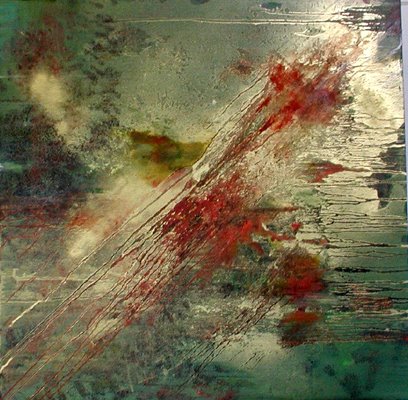
*Barbara Mink is an Ithaca artist who is grasping her way into this domain. Her half of a two-person show back in August contained rich, painterly abstractions that move away from her earlier, more recognizably landscape inspired work. An included statement cited the influences of natural diasters and Hubble space telescope imagery. (Regretably, I don't have a copy of the statement right now; if Barbara or anybody else wants to send it to me, I'll consider posting it here.) I think the work isn't quite living up to the concept yet; nevetheless, they are beautiful paintings. I review an earlier show of hers here.

*Other artists working within "the long zoom" occupy a disproportionate number of slots under the heading "Artists" in my sidebar. They are representatives of what I consider to be one of the most promising developments in recent art. Check them out.

*Natasha Pickowicz (my boss!) has a short essay on a recent local performance by (the) Small Sails. I was there myself, and was mesmerized by their spacey, electro-acoustic sounds and backing video projections. The theatre (one of Cornell's cinematheques) was almost completely dark; at times I would forget that there were actual live musicians performing onstage. I still don't know what the performers look like.

*Local artist Steve Poleskie's blog is among my favorites. He has done everything from realistic portraiture to "aerial theatre". In the early to mid sixties, he lived in New York City, where he founded and ran the screenprinting studio Chiron Press. He worked there with a broad cross-section of the New York artworld. Needless to say, he knows some interesting characters. He came to Ithaca to teach at Cornell in 1968 and has mostly lived here since. He also has a new historical novel
, The Balloonist, to be published soon. His blog revolves around his long and fascinating life, as well as new projects of his.

*Warren Craghead's a map's little spell is an innovative combination of hand drawing, collage, and web interactivity. It explores some of the weirder aspects of the familiar suburban landscape. It is strangely reminiscent of the "computer games" I used to write as a child on some primitive Mac.

*I've been enjoying Matt Madden's sweet, playful meta-comic 99 Ways to Tell a Story: Exercises in Style, which you can preview here. Based on the format of French writer Raymond Queneau's own classic Exercises (also highly recommended), he repeats nearly one-hundred times the banal incident of a man getting up from his work to go to the refrigerator. Each reiteration is done a different way. Formal elements are rearranged and various popular comics genres (daily strip, fantasy, horror, superhero, etc.) are pastisched. Its tremendously entertaining.

Labels: , ,