Wednesday, November 14, 2007

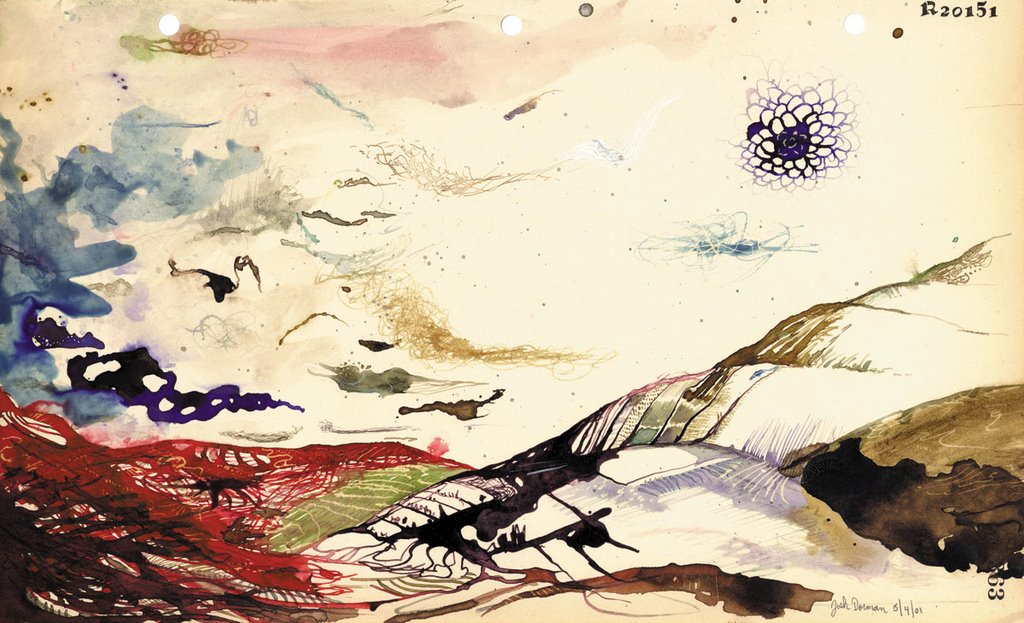
josh dorman on his paintings

Part of the public television documentary There is a Bridge, on Alzheimer's disease. This segment features painter Josh Dorman.

Labels: , ,

Sunday, November 11, 2007

links and announcements for a sunday afternoon in november

* Mr. Schjeldahl and Mrs. Smith on the Seurat drawing show at MoMA.

*"The Twelve Devices of Peanuts." (via)


*A hand-drawn map depicting most of the traversable terrain in the classic computer game Zork.

*MIT is suing Frank Gehry. They are alleging negligence in the design of their 300 million dollar Stata Center, which opened back in 2004. (via)

*Mark Steyn on Allan Bloom on rock'n' roll. (via)

*The Great Pumpkin.

*From this weekend's Ithaca Journal: Carol Kammen on blogs as popular history.

*Nancy Geyer on the big video art extravaganza currently taking up most of the Johnson Museum's temporary exhibition space. I need to get up there and see it myself.

*Local artist Jay Hart is showing examples of his "terrain art" at Cornell's Mann Library Gallery. The show will be up through January 10 with a reception taking place this coming Tuesday from 5 to 6 in the evening. I do fetishize aerial perspective in art and there seem to be at least a handful of local artists working (with various levels of abstraction) in this vein. More on this sometime, I think.

*Speaking of which, my hero, the Queens painter Josh Dorman has taken part in a television documentary, There is a Bridge. The show, narrated by Mr. Robert Pinsky, deals with some of the social and humanistic aspects of Alzheimer's disease. From their website:
Josh Dorman, a nationally recognized artist living in New York, came to Alden Town Manor Rehabilitation and Health Care Center in Cicero, Ill., in August 2005 to create five paintings based on the imaginative and emotional landscapes of five people with advanced dementia. Assisted by Michael Verde of Memory Bridge and two social workers from Northwestern University, Josh spent six hours a day with five residents of Alden Town Manor. The thoughts, feelings, memories, dreams, and whatever else residents chose to share with Josh provided him the imaginative material from which he created his paintings. Josh earned a B.A from Skidmore College and an M.F.A. from Queens College.
You can see the paintings here. They incorporate literal portraiture, something I don't thing I've seen before in Dorman's work. (There is an interesting parallel here with some of Barbara Mink's recent work.)

The show is airing on various public tv stations at different times; depending on where you live, you may have missed it. Locally, it can be seen on WCNY on the 18th of this month, at 11 in the morning. I hardly watch television, but I will be making an exception.

*I Am Sitting in a Room (more), a classic sound piece by experimental composer Alvin Lucier:
I am sitting in a room different from the one you are in now. I am recording the sound of my speaking voice and I am going to play it back into the room again and again until the resonant frequencies of the room reinforce themselves so that any semblance of my speech with perhaps the exception of rhythm, is destroyed. What you will hear, then, are the natural resonant frequencies of the room articulated by speech. I regard this activity not so much as a demonstration of a physical fact, but more as a way to smooth out any irregularities my speech might have.

Labels: , , , , ,

Wednesday, March 01, 2006

Some Thoughts on Landscape

As Nancy Geyer points out in this thoughtful comment, Ithaca is indeed "inundated with uninspired landscape paintings"; she also points to a similar problem with with landscape photography. Works—often not very well done—do look as if they "could have been painted centuries ago". Since I agree that this an issue (and not just here, I've seen similar work living in Boston), let me offer a few ideas, not all of them specific to the problem of landscape. Also, these may be slanted more towards painting and drawing (my own focus as an artist), than photography or other media. The point is to suggest alternatives to cliche.

*Artists should be aware of art history. This means both breadth and depth. They should look at what artists from a wide range of times and places have done, and have some sense of how it all interrelates. However, it is also important to look closer at things
—artists, styles, movements, techniques—that you find particularly interesting or useful. This is important for everyone, but perhaps particularly for those who see themselves as traditionalists. Being a traditionalist without (fully) understanding the tradition in question is a big problem, often leading to bodies of work that are confused and directionless (and boring).

*Artists should be familiar with a wide range of contemporary art. Obviously, this doesn't mean simply looking to jump on whatever the latest bandwagon is, nor does it mean uncritical approval. It does mean being aware of what your options are. It generally doesn't make much sense to just pick a date and say that nothing that developed after that is any good (unless you really know what you're talking about, which is rare). Travel, read, go to school
—do what you have to do.

*Look at the connection between landscape and abstraction. Many if not most of the early abstractionists (Mondrian, Kandinsky, Klee, O'Keefe, many others) developed this direction out of earlier work in landscape. You can see precursors of this approach in earlier landscape painting
—for example the work of J.M.W. Turner. Landscape can take us away from our usual sense of scale, away from the world of familiar people and objects. It can be macroscopic or microscopic. It can incorporate distortions, other ways of seeing and depicting. NYC artist Josh Dorman (more pictures here and here) does all of this ingeniously. Also worth paying attention to are locals Barbara Mink and (more interestingly) Barbara Page.

*Landscape doesn't have to be pastoral. Cataclysm and chaos are a big part of the natural world. Likewise, violence is central to our culture (and others as well). Local printmaker Craig Mains (see my last post) is a good example, as is (my former teacher) painter Gerry Bergstein (more information and pictures here and here), sculptor Heide Fasnacht, as well as (again) Turner.

*Landscape isn't just natural landscape. It should go without saying that we are constantly surrounded by man-made things, even in the countryside. The interweaving of the natural and the artificial (even to the point where these categories can become blurred) is a particularly interesting subject.

I'm not a art teacher, so I don't have any clear ideas about what should be done in this field. Although I do think traditional techniques and approaches should be taught, I don't think its a good idea to simply pretend that we're living in the nineteenth century.

Labels: , , , ,