Thursday, January 10, 2008

calamity

I am saddened to learn (via the internet) that the Ink Shop was one of several victims in a fire that took place downtown at the 102-104 West State Street building during the final hours of Tuesday night. The cause is apparently unclear. According to Thursday's Ithaca Journal, the blaze began in the the third (top) floor studio belonging to the Ithaca Academy of Dance. The Shop is right below but luckily did not face flames. Reportedly, "the second floor suffered moderate water damage, and the third floor and roof suffered major damage". I shudder to think about what "moderate" means, given the high-profile EPI show that was hanging, as well as whatever was in storage. We'll see.

According to this second Journal article:
The Ithaca community was quick to offer help to the businesses affected by the fire. The Ink Shop Printmaking Center, on the second floor of the damaged building, has experienced an outpouring of community support. The shop's current exhibition, which displayed a group of prints from Lafayette College, was the most expensive one ever to be in the space.

“We think it's amazing how the downtown area has immediately offered support,” said Christa Wolf, president of the Ink Shop board of directors.

The Ink Shop was granted several spaces that will allow it to continue operating. The State Theatre provided an apartment above its box office to put the damaged prints, the Community Arts Partnership offered the shop a space in the Clinton House to display the coming “Light in Winter” show as scheduled Jan. 18, and Dryden High School promised the use of its ink shop as a place to hold workshops.

“We thought we would be renting a truck and renting a spot to put everything, but (the response) has just been great,” Wolf said.

The rest of it goes into the impact of the disaster on the dance studio and on the street-level Handwork, a cooperative crafts store.

Needless to say, this is a major loss for the local arts community, and in particular to the numerous talented artists who have made the Shop their home. I would like to offer my condolences. I'll take a look there myself in the morning.

The Journal also has a picture gallery of the firefighters in action.

Labels: , , ,

retrospective

From the Times, looking back on 2007:
Following tradition, I've put together a year-end list of notable shows, artists, and venues from 2007. The list is not comprehensive and is in no particular order. My focus is mostly on shows that I've reviewed for these pages and, consequently, mostly on shows in the Ithaca area. In addition, this was my first full year as a regularly published newspaper critic.

1) Syau-Cheng Lai: Lai, a local artist, had a pair of excellent Ithaca shows. "Visualizing for Bunita Marcus" accompanied her performance of Morton Feldman's solo piano "For Bunita Marcus". Held in Cornell's Tjaden Gallery, the exhibit featured four long sheets of paper pinned directly to the walls. Using a wide range of wet and dry media, Lai created a sequence, beginning sparsely before developing dense strata of varied marks in rich colors (including gold and electric pink), finally petering back out into paper white. The piece is notable for its repetition and layering of different motifs. Letter-like forms and scribbles are prevalent, as are horizontal strokes and bands of color. On display for just five days in early February (2/5-9) and located in a obscure space, "Visualizing" was easy to miss. [See also my pictures: 1, 2, 3, 4.]

"Transformations," her two-woman show at the Upstairs Gallery (5/1-6/2) was just slightly less exhilarating. The show was a valuable complement to "Visualizing," as well as being powerful in its own right. Consisting as it did of work reaching back to the early part of the decade, it was more eclectic. The images are even denser, most with little or none of the white space that carries through "Visualizing." Although predominantly abstract, some of the pieces have more or less explicit references to landscape, often to the nautical.

2) Kumi Korf at The Main Street Gallery: Korf (also local) is best known as a printmaker and book artist. In 2007, she had substantial shows of her print-work in San Francisco and in her native Japan. "Paintings by Kumi Korf" (9/7-10/21) gave the local community a rare chance to see another side of her practice. Characteristically, the show combined abstraction with a sensibility rooted in nature.

The show was dominated by a pair of enormous acrylic paintings done on unprimed canvas. Each is of roughly human height and two to three times that in length. Together, they filled the gallery's oddly-angled front gallery. Korf treats the paint in a way analogous to watercolor, staining the fabric rather than covering it. While An Amphora and a Fish features graceful, rounded calligraphic shapes, A Clear Day has coarse, drippy blocks of (less diluted) color.

They were complemented by a generous selection of small pieces on paper hanging in the small back room. Included were a series of pieces in pastel and another in thick, greasy oil-stick.

3) The Ink Shop: The downtown printmaking cooperative's shows have been both diverse and almost uniformly strong. In addition, they have put on an impressive array of public talks and classes. With that said, no one show sticks out as the winner.

The current show (through 1/14) features work by nationally known artists such as Sam Gilliam and David Driskell. All prints are the work of Lafayette College's Experimental Printmaking Institute; EPI director Curlee Raven Holton (who has art in the show) gave an enthusiastic and well-received talk about his work there. Jenny Pope's "Kiwi Egg Soup" showed-off her playful, high-contrast color woodcuts of animals, both familiar and exotic. Stretching back into 2006, IC professor Susan Weisend's "Garden: Delights and Detritus" mixed mediums, styles, and formats in an almost reckless manner. Her best work enlivens or disrupts her pastoral flora and fauna through formal experimentation.

4) Out of Town Shows: Lane Twitchell and Alan Singer: I travelled for two Times reviews - to Auburn's Schweinfurth Memorial Art Center for Twitchell's "Revelation" (9/1-10/27) and to Syracuse's Redhouse Arts Center for Singer's "Cosmology" (9/20-11/08). Twitchell's jewel-like cut paper on panel collage-paintings were more impressive. His ornate compositions are packed with imagery relating to the Brooklyn artist's Utah Mormon upbringing as well as to American urbanism and to art history. They are typically large and are notable for their often off-kilter symmetry.

Singer is from Rochester. "Cosmology" was made up primarily of digital prints with hand-painting. This mixture of technique and texture gives the work a latter-day Surrealist feel as does Singer's taste for abstract, three-dimensional geometric forms and spaces placed alongside suggestions of human or otherwise organic form. Although some of the pieces feel over the top, his best work has a vibrant and meticulously crafted theatricality.

5) "Stop. Look. Listen: An Exhibition of Video Works" at the Johnson Museum: This ostentatious and highly uneven show (10/13-12/23) filled nearly all of the museum's temporary exhibition space and incorporated a night-time projection (of Janine Antoni's Touch) on the building's facade. It represents a culmination of several years of focused video collecting. Nancy Geyer reviewed it ably for this paper.

Works were divided into "feedback" and "immersion" modes, the former treating the camera as simply as a "electronic mirror" and the latter taking a more high-production, cinema-like approach. Works in the latter category were generally stronger. Among these were such standouts as Mircea Cantor's Deeparture - in which the camera gracefully tracks a wolf and a deer around a silent, white-walled space - and Amy Jenkins' macabre but subtle Ebb - in which the image of a bathing woman is projected on to a miniature ceramic tub. Gradually she purifies the at first bloody water.

6) "Looking Homeward: A Century of American Art" at the Johnson Museum: (7/7-9/23) This historical survey ran from turn-of-the-century Impressionism to the present. It was a more consistent effort than Stop., although its historical focus wavered for the postwar years. The show was particularly strong in its representation of the early 20th-century Ashcan school, a group known for their gritty portrayals of contemporary urban life. Group leader Robert Henri's Patience (1915) - a brushy portrait of a dark haired young boy reminiscent of Manet - was a standout. The show was also strong in early to mid-century modernist figuration, with pieces like Milton Avery's 1941 The Brown Hat (a young girl painted in flattened forms, mostly black, white, brown and tan) and a characteristic small female portrait by Willem de Kooning (1947). Other highlights included Reginald Marsh's satirical watercolor of wealthy folks atop the Grand Tier at the Met (1939) and a shadowy, enigmatic gelatin-silver photo by Imogen Cunningham, Eiko's Hands (1971).


While Ithaca has more than its share of good artists, many are unable (or unwilling) to show locally on a regular basis, or at least not in venues where their work will be fully recognized. While it is legitimate to show work in a café or restaurant, it can be difficult for aficionados, collectors, and critics to trace such efforts. A great deal of work is shown at Cornell, much of it by students or faculty. Aside from exhibits at the high-profile Johnson Museum, these are often invisible to the community at-large. The State of the Art Gallery is members-only, excepting its annual juried and invitational shows. Finally, several of the more established artists living in the area choose to show their work elsewhere.

I have tried to highlight some of these lesser-known artists and art spaces. For example, I reviewed Jay Hart's satellite graphics at Cornell's Mann Library (up through Jan. 10). While Lai is relatively well-known, the Tjaden and its programming is not.

As strong as it is, Ithaca's art world suffers in comparison to the talent and eclecticism of the music scene. I believe that some of the reasons for this are systematic - not that that's any reason for complacency. Music is more socially fluid in our culture; the prevalence of recording as a medium of creativity and exchange contrasts with art's focus on unique objects and limited multiples. While this is a good thing in many ways, it also constrains the dissemination of artworks and artistic ideas, and musicians travel extensively while artists tend to stay put. The result of all this is that it is impossible to see all the art you need to in a small town. Although cultural isolation can have its advantages, I believe that on balance, it is not a good thing for Ithaca.

Labels: , ,

Saturday, December 08, 2007

happening

I attended the downtown Gallery Night openings yesterday. Things seemed particularly festive and well-attended, no doubt due in part to the shopping season. Special events may have also played a part. NYC painter-printmaker Maddy Rosenberg was having a launch party for her new sculptural book, Dystopia at the Ink Shop. It is being published by the Shop's own Olive Branch Press and features black and white linocut images of architectural fantasia. You can see it on her website although I can't link directly to it. It looks good.

The Art Bar Gallery is open every year for about a month during the holiday season. Their gimmick is to sell fine Swiss chocolate bars, each with a collectible card featuring the work of one of the gallery artists. (Buzz Spector, featured a few years back, suggests the inclusion of stats.) As in past years, the artists are from both Ithaca and all around. The concept is fun and the art
while generally a mixed-bagis at least something different. And they had champagne and chocolate cake at the opening.

A common characteristic was for the December shows to be markets rather than carefully assembled productions. Which is essentially what many of them are anyway, so perhaps its better to drop the more elevated pretenses.

Next Tuesday evening, I'll be driving down to Elmira (NY) with my Times colleague Wylie Schwartz to check out the Rural Research Labs, an artist's collective and exhibitions space. They're holding a press reception, though who knows who else will show up.

In other news, I will be spending about two weeks with my brother and motley housemates in San Francisco. I'll be flying out from Syracuse on the 14th. I'm looking forward to exploring the city, to which I've never been. The fifty five degree weather should also be nice.

Art-wise, it appears that SFMOMA is showing Joseph Cornell: Navigating The Imagination, which I got to see last winter in D.C.. The show was lovely but also too much to see in one visit, especially given the small-scale intricacy of Cornell's boxes. And they have a little Klee drawings show! At least two people I know personally are showing in the galleries. Kumi Korf's quiet calligraphic abstract prints are up at Chandler Fine Art and Framing. Jamie Vasta (a SF local I know from art school) is showing carefully crafted glitter paintings at Patricia Sweetow.

With any luck, I'll be able to blog from the West Coast. Otherwise, expect a flurry of posts around the beginning of next year.

Labels: , ,

Sunday, November 11, 2007

links and announcements for a sunday afternoon in november

* Mr. Schjeldahl and Mrs. Smith on the Seurat drawing show at MoMA.

*"The Twelve Devices of Peanuts." (via)


*A hand-drawn map depicting most of the traversable terrain in the classic computer game Zork.

*MIT is suing Frank Gehry. They are alleging negligence in the design of their 300 million dollar Stata Center, which opened back in 2004. (via)

*Mark Steyn on Allan Bloom on rock'n' roll. (via)

*The Great Pumpkin.

*From this weekend's Ithaca Journal: Carol Kammen on blogs as popular history.

*Nancy Geyer on the big video art extravaganza currently taking up most of the Johnson Museum's temporary exhibition space. I need to get up there and see it myself.

*Local artist Jay Hart is showing examples of his "terrain art" at Cornell's Mann Library Gallery. The show will be up through January 10 with a reception taking place this coming Tuesday from 5 to 6 in the evening. I do fetishize aerial perspective in art and there seem to be at least a handful of local artists working (with various levels of abstraction) in this vein. More on this sometime, I think.

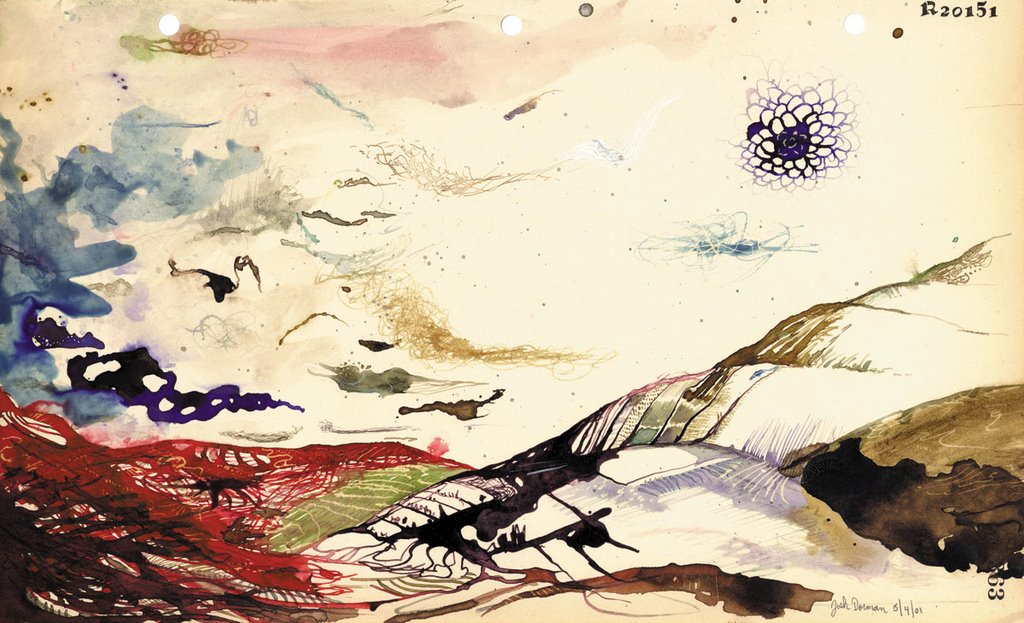
*Speaking of which, my hero, the Queens painter Josh Dorman has taken part in a television documentary, There is a Bridge. The show, narrated by Mr. Robert Pinsky, deals with some of the social and humanistic aspects of Alzheimer's disease. From their website:
Josh Dorman, a nationally recognized artist living in New York, came to Alden Town Manor Rehabilitation and Health Care Center in Cicero, Ill., in August 2005 to create five paintings based on the imaginative and emotional landscapes of five people with advanced dementia. Assisted by Michael Verde of Memory Bridge and two social workers from Northwestern University, Josh spent six hours a day with five residents of Alden Town Manor. The thoughts, feelings, memories, dreams, and whatever else residents chose to share with Josh provided him the imaginative material from which he created his paintings. Josh earned a B.A from Skidmore College and an M.F.A. from Queens College.
You can see the paintings here. They incorporate literal portraiture, something I don't thing I've seen before in Dorman's work. (There is an interesting parallel here with some of Barbara Mink's recent work.)

The show is airing on various public tv stations at different times; depending on where you live, you may have missed it. Locally, it can be seen on WCNY on the 18th of this month, at 11 in the morning. I hardly watch television, but I will be making an exception.

*I Am Sitting in a Room (more), a classic sound piece by experimental composer Alvin Lucier:
I am sitting in a room different from the one you are in now. I am recording the sound of my speaking voice and I am going to play it back into the room again and again until the resonant frequencies of the room reinforce themselves so that any semblance of my speech with perhaps the exception of rhythm, is destroyed. What you will hear, then, are the natural resonant frequencies of the room articulated by speech. I regard this activity not so much as a demonstration of a physical fact, but more as a way to smooth out any irregularities my speech might have.

Labels: , , , , ,

Saturday, August 25, 2007

"you can forget all your troubles forget all you cares"

Sorry, of course, for the lack of posting. A most of you probably know, things are awfully quiet culture-wise in a small Upstate college town during late summer. And just as surely, things start finally to pick up around now. Time, to be sure, to to come up from hibernation. Unfourtunately, my Mac has chosen this precise moment to go on the fritz (I won't bore you with details, but it looks serious), but no matter.

I have an exciting personal announcement. As of last Thursday, I am the proud renter of this downtown office space, which I plan to use both for my art writing (with a typewriter, perhaps?) and hopefully to revive my long abandoned painting career (more on that one soon). The space is particularly ideal for the former purpose, being within a few blocks of perhaps half of my customary gallery haunts. It is on the top foor (the fourth) of an old building dating, or so I was told, to the 1910's. The view of the road is nice and the ceilings feel generously high. Neighbours include a mixture of artsy types, an attorney, and an office belonging U.S. House Representative Maurice Hinchey, whose gerrymandered district just happens to include Ithaca. The building is also adjacent to city hall and connects to it via a pair of bridges.

And it feels good to have a foothold downtown. As much as I like to complain about the hideboundness of local art there are lot going of other things going on
a lively and varied music scene, for one. Hopefully, some of the ambient energy will rub off.

Labels: ,

Thursday, April 05, 2007

avant-garde and quiche

More news of possible interest to local readers: The Constance Saltonstall Foundation is reviving their lively (if slightly expensive) Salon series, last seen about a year ago. (I covered one of the less interesting ones here.) Last year's events featured guest speakers, formal and informal discussion, and light foodyou get the idea. The information and schedule, as shown the CSF website:

Let the Conversations Begin!
Sundays in April, May, June

Watercress Restaurant
C
orner of Triphammer and Hickory Hollow Lane, just north of Pyramid Mall

A MONTHLY LITERARY SALON that is open to the public. Enjoy an exquisite Sunday brunch and presentation from some of our brightest local minds (see names below). A lovely spring afternoon filled with real community: a little food, a little conversation and lots of stories.

Brunch begins at 11:00 am; speaker at 12:15 pm. $15 per person, per event. Reservations are required. Call Watercress at 257.0823.

APRIL 15, 2007

MICHAEL KAMMEN

Cornell Professor and Pulitzer Prize-winning historian, has chronicled art and controversy throughout America’s history in his book Visual Shock. The triumph of freedom of expression over censorship of public art is
quite a tale in this fascinating survey of art-related battles.
MAY 6, 2007 PATRICIA ZIMMERMAN

Ithaca College Professor of Cinema, Photography and Media Arts, co-director of the Finger Lakes Environmental Film Festival, and recent panelist at the Sundance Film Festival, will provide a lively and fresh perspective on our region in “Hidden Vectors: Art, Technology, and Economics in Upstate New York.”

JUN 10, 2007 GILLIAN PEDERSON-KRAG
Fondly claimed by Ithaca and much admired nationally for painting, printmaking and her perceptive mind, this former Cornell professor will examine "The Purpose of Art,” adding her own insights about what’s driving taste today.
Strange that these are described as "literary salons", given the apparent visual-arts orientations of the speakers. Also, I prefer having the salons in a museum to having them in an upscale-ish restaurant. It seems like a more inclusive kind of space.

Labels:

Wednesday, March 01, 2006

Some Thoughts on Landscape

As Nancy Geyer points out in this thoughtful comment, Ithaca is indeed "inundated with uninspired landscape paintings"; she also points to a similar problem with with landscape photography. Works—often not very well done—do look as if they "could have been painted centuries ago". Since I agree that this an issue (and not just here, I've seen similar work living in Boston), let me offer a few ideas, not all of them specific to the problem of landscape. Also, these may be slanted more towards painting and drawing (my own focus as an artist), than photography or other media. The point is to suggest alternatives to cliche.

*Artists should be aware of art history. This means both breadth and depth. They should look at what artists from a wide range of times and places have done, and have some sense of how it all interrelates. However, it is also important to look closer at things
—artists, styles, movements, techniques—that you find particularly interesting or useful. This is important for everyone, but perhaps particularly for those who see themselves as traditionalists. Being a traditionalist without (fully) understanding the tradition in question is a big problem, often leading to bodies of work that are confused and directionless (and boring).

*Artists should be familiar with a wide range of contemporary art. Obviously, this doesn't mean simply looking to jump on whatever the latest bandwagon is, nor does it mean uncritical approval. It does mean being aware of what your options are. It generally doesn't make much sense to just pick a date and say that nothing that developed after that is any good (unless you really know what you're talking about, which is rare). Travel, read, go to school
—do what you have to do.

*Look at the connection between landscape and abstraction. Many if not most of the early abstractionists (Mondrian, Kandinsky, Klee, O'Keefe, many others) developed this direction out of earlier work in landscape. You can see precursors of this approach in earlier landscape painting
—for example the work of J.M.W. Turner. Landscape can take us away from our usual sense of scale, away from the world of familiar people and objects. It can be macroscopic or microscopic. It can incorporate distortions, other ways of seeing and depicting. NYC artist Josh Dorman (more pictures here and here) does all of this ingeniously. Also worth paying attention to are locals Barbara Mink and (more interestingly) Barbara Page.

*Landscape doesn't have to be pastoral. Cataclysm and chaos are a big part of the natural world. Likewise, violence is central to our culture (and others as well). Local printmaker Craig Mains (see my last post) is a good example, as is (my former teacher) painter Gerry Bergstein (more information and pictures here and here), sculptor Heide Fasnacht, as well as (again) Turner.

*Landscape isn't just natural landscape. It should go without saying that we are constantly surrounded by man-made things, even in the countryside. The interweaving of the natural and the artificial (even to the point where these categories can become blurred) is a particularly interesting subject.

I'm not a art teacher, so I don't have any clear ideas about what should be done in this field. Although I do think traditional techniques and approaches should be taught, I don't think its a good idea to simply pretend that we're living in the nineteenth century.

Labels: , , , ,

Sunday, February 26, 2006

Saltonstall Salon

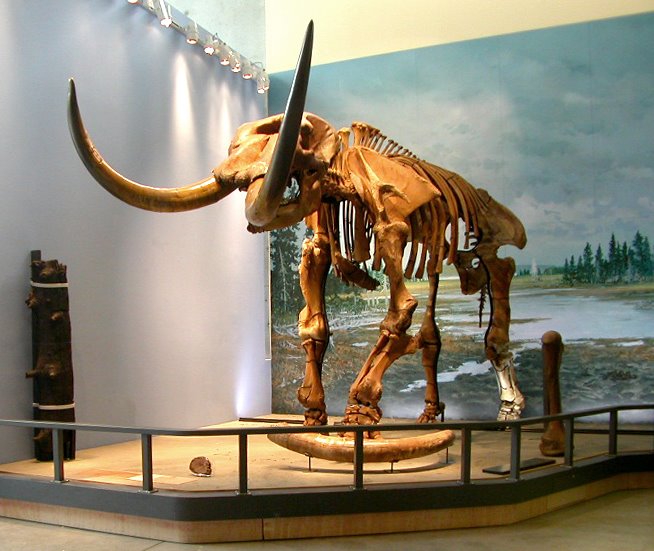
Today, I attended the second installment of the Saltonstall Foundation's new Art Salon series, which takes place at the Museum of the Earth, a natural history collection. The striking, angular building, filled with fossils and artwork depicting long extinct lifeforms, was a fun and offbeat locale for discussions of contemporary artists and their work. I got there early, so I got a chance to wander the museum, which I hadn't been able to do at the first Salon. The recently discovered Hyde Park Mastodon, almost (95%) complete, was impressive. (If you want to, you can sponsor one of the bones.)

There was light food, coffee and tea, set up by the catering people. I'm not sure what the numbers were, but I think that there were substantially fewer visitors than last time. Perhaps the weather, which was cold and windy? There were four speakers; each was supposed to talk for ten minutes, although this wasn't rigorously enforced. Many of them were quite awkward as public speakers, which seems to be the case with many visual artists (and something that I certainly identify with myself). Each artist was introduced by Laurel Guy, director of the Foundation. All brought samples of their work, and stayed around after the formal talks to chat with visitors.

First to speak was Virginia Cobey, who showed landscape paintings, as well as "abstracts". (This latter usage is probably out of date, and I have to say that I find it awkward.) She described her working schedule: plein-air landscapes when it is warm out, abstractions in her studio during the wintertime. Her emphasis was on the formal aspects of her work: selecting a composition from nature, building contrasts of shape and tone, establishing unity, and so forth. Much of this seemed generic (not particularly specific to her own work), and the talk was for the most part pretty dry.

Craig Mains, my favorite artist of the group, spoke next. Mains had a solo exhibit of his work at the Ink Shop last fall, and another one at Gimme Coffee earlier this year (an show from 2004 is reviewed colorfully here). Particularly nervous, he warned the crowd that he might suddenly stop talking (which luckily didn't happen).

First, he discussed his symbolic approach, which incorporates icons of disaster and flux (or icons in flux). Houses, trailers, ice-cream trucks, telephone poles, trees, Cessnas, helicopters, and more suffer the ravages of wind, fire and flooding. He noted the human attraction to such chaos and destruction, which he wants to separate from the human tragedy that usually accompanies it in the real world.

He also discussed his technical process, which has unusual aspects. He applys wet media (usually watercolor) to porous acetate sheets, which he can run through a printing press. Often, he cuts his iconic forms out, arranging and rearranging them. Although the monotype process is meant to produce a singular, unique image, Mains reuses these cutouts in further images, in which they grow progressively fainter as the pigment fades. Images and their "ghosts" are used to form series. He also talked about his use of Internet search engines as a source of imagery, which sometimes produces unexpected but useful juxtapositions
—for example, a search for "high tension wires" producing an image of a downed helicopter.

Bill Roberts, who teaches at Wells College, talked after Mains. He spoke engagingly about his life history, but didn't have too much to say about his current painting, a series of "shaped" (non-rectangular) pieces inspired by Elizabeth Murray's work. These pieces, done mostly in pinks, blues and whites reference the notorious "dimpled chads" from the 2000 election, which seemed like a pretty forced attempt at humor. Some of his earlier work, reproduced in catalogs he was giving away, looked more interesting. He also spoke about his work as a sports photographer (football and horse racing), and his love of Spain and its culture and art.

His philosophy of teaching was presented as a series of cliches, likely familiar to anyone who has attended art school: be spontaneous, experiment, be willing to fail, value the process of making art over the results, be fufilled in life. (He reminds me of a particular teacher I had in art school about whom I have very mixed feelings.) I don't know if Roberts is a good teacher or not, but I personally don't find these truisms very useful or encouraging.

Linda Swanson, a ceramic artist currently attending grad school at Alfred University, was the last to get up. Her work, inspired by the landscape of Iceland, uses natural processes such as dripping, cracking, and the formation of crystals, which act in unanticipated ways. Unlike the other artists, she read from notes for much of her talk, which gave it an strangely academic tone, seemingly out of place. She spoke of an interest in referencing the geological and the biological, different scales, mapping the landscape. The difference between science and art is important for her; the latter allows for things to be "other than what they are", which is a nice way of putting it.

Swanson showed two circular porcelain pieces, meant to be hung on a wall, although they were shown on a table instead (due to a lack of set-up time). The pieces were coated in thick layers of glaze, which were deliberately allowed to crack. One was white, black, and red, and the other (my favorite of the two) a pond-like green, with white crystal growths. The pieces receded behind their metal frames.

The quality of both the artists' talks and their work (which seem to correlate), was more uneven than at the first Salon, which is too bad. Still, it was an enjoyable event. I'm looking forward to the next one, which takes place on March 26.

Labels: ,

Thursday, February 09, 2006

Eye Opening

I've been meaning to get thing this up for a little while now; my goal here is to create a record of my changing ideas and opinions about the visual arts. I am a painter (look here if you don't believe me), a graduate of the School of the Museum of Fine Arts in Boston, and an aspiring art writer. I am currently living in Ithaca, somewhere in upstate New York.

This blog is intended for two distinct (if overlapping) audiences: a local one, as well as one involved with (or at least knowledgeable about) the broader field of contemporary art. Why write about art in a small town, isolated from the centers of the art world? Well, first of all, I believe that art is something that should be experienced directly (without excessive mediation) whenever possible. While I do read more than my fair share of books, magazines and web-based material pertaining to art, I can't imagine these being the sole basis for my writing here. Since I haven't been traveling much (although this will hopefully change), a local focus is probably inevitable. Secondly, I would like to make a contribution to local culture, both for idealistic and selfish reasons. There is a good amount of interesting art going on around here, but I think that the dialogue (among other things) could be strengthened. As Laurel Guy, Program Director at the Constance Saltonstall Foundation says in this article,
"there are a whole bunch of small cells all over the place, because people find like-minded people, and in that sense there is a community - but there's no arts center." The article is nearly two years old, but the main point seems to me still largely valid, this despite the Foundation's own worthy efforts, which continue. Actually, I think there should be multiple art centers. One of my goals for this blog is to become one such center, so anybody who shares these local-minded goals is welcome to respond. (Needless to say, everyone else should feel free to do the same.)

Anyway, I hope to start posting here regularly. On Thursday evening, I attended an artist's talk given by the photographer Linda Butler at the Herbert F. Johnson Museum of Art. She has work up there vividly illustrating the Three Gorges Dam project currently underway on the Yangtze River in China. I want to discuss both the talk and the show in some detail, and I've written quite a bit here already, so this will have to be a separate post.

Labels: , ,