Wednesday, November 28, 2007

d.c. diary

I spent the recent holiday with relatives in some desolate D.C. suburb, which honestly was not so much fun. But I did get the chance to consume a couple stray bits of culture. Some brief notes then.

First, and most significantly, I saw Morris Louis Now, a small retrospective, at the Hirschhorn. I have nothing original or intellectual to say about the man or his work right now. (I have too many other writing projects at the moment. Also, I'm just at a loss for words.) But I will say that these stained acrylic on canvas abstractions are among the most gorgeous things that I've seen this year. Their combination of cool analytic order and deeply sensuous color is intoxicating. I wish I could go back. I particularly like the wide empty spaces of his late late work (bare canvas!).

My favorites might be the so-called "unfurled" series, in which the artist dripped diagonal rivers of thinned (but saturated) color from the side edges. Here is an example. It's an intriguing compositional device; I'm not sure where else in the history of art it can be found. In Chinese painting, perhaps?

From the museum site linked to above:
The exhibition presents major paintings dating from the early 1950s until his death in late 1962, the years Louis developed an innovative method of painting by staining his unprimed canvases with thinned washes of acrylic pigments. The artist, who was born in Baltimore, Maryland, in 1912, studied at the Maryland Institute of Fine and Applied Arts. As a young man he painted in a realist manner; only in his forties did he find his signature style. Even in cramped quarters in Washington D.C., Louis was able to make large paintings, achieving an exuberant, lyrical celebration of colors hovering in white space. Louis became an inspirational figure for other artists in the Color Field movement in the 1960s, notably Kenneth Noland and Helen Frankenthaler.
According to the same source, Louis has not had a retro since 1986 (when I was a kid), which is shocking. Needless to say, I am unable to compare this one with others. But the size and selection felt perfect to me, given that a little of his work goes such a long way.

And I read a short novel: Mark Dunn's fun, wordplay-laden Ella Minnow Pea. The book is written as series of letters, most of them between two teenage girl cousins: Ella and Tassie. The events described therein take place on Nollop, a fictional island off the South Carolina coast. The island is named after Nevin Nollop, the author (also fictional) of the sentence "the quick brown fox jumps over the lazy dog," which is a pangram, containing all the letters of the alphabet. As evinced by the exchanged epistles, with their alliteration and ornate, precious usage, the islanders have an unusual fondness for language. (This is entertaining some times and annoying at others.)

Nevin is worshiped as a godlike figure, and when letters start falling off of his memorial statue
off of the pangramthey are successively banned by the superstitious, tyrannical Council. First time offenders get off with a mere scolding, but a second violation brings a choice of flogging or the stockade. A third time brings expulsion from the would-be linguistic utopia. The novel tells of the progressive devolution of the society as a result of communicative breakdown and the departure of people (voluntarily or otherwise). The letterswith some exceptionsfollow the law lipogrammatically, with humorous results. Later sections are clouded with increasingly evasive, absurd substitutions and mispellings.

Ella must demythologize Mr. Nollop in order to discredit the theocracy. To this end, she endevours to find another pangrammatic sentence with 32 or fewer letters. She is assisted in this task by others, including the renegade councilman Rederick Lyttle (hah) and Stateside scholar Nate Warren (with the predictable love story between Tassie and the latter). I'm sure you can guess how things turn out.

Ella is lighthearted and light-weight as a satire of theocracy and censorship. The wordplay, and the writing more generally, was however, a joy to read.

Labels: , , ,

Tuesday, October 09, 2007

a worm chewing its own tail


Theodoros Pelecanos, 1478
L'art pour l'art. The fight against purpose in art is always a fight against the moralizing tendency in art, against its subordination to morality. L'art pour l'art means: "The devil take morality!" But even this hostility still betrays the overpowering force of the prejudice. When the purpose of moral preaching and of improving man has been excluded from art, it still does not follow by any means that art is altogether purposeless, aimless, senseless—in short, l'art pour l'art, a worm chewing its own tail. "Rather no purpose at all than a moral purpose!"—that is the talk of mere passion. A psychologist, on the other hand, asks: what does all art do? does it not praise? glorify? choose? prefer? With all this it strengthens or weakens certain valuations. Is this merely a "moreover"? an accident? something in which the artist's instinct had no share? Or is it not the very presupposition of the artist's ability? Does his basic instinct aim at art, or rather at the sense of art, at life? at a desirability of life? Art is the great stimulant to life: how could one understand it as purposeless, as aimless, as l'art pour l'art?
Friedrich Nietzsche, Twilight of the Idols

Labels: , ,

Tuesday, July 03, 2007

intimation of grace

On a more serious note, Perec on the phenomenology of puzzles (from pages 338-339):
Fortunately, it was more usual for Bartlebooth, at the end of such hours of waiting, having gone through every stage of controlled anxiety and exasperation, to reach a kind of ecstasy, a stasis, a sort of utterly oriental stupor, akin, perhaps, to the state archers strive to reach: profound oblivion of the body and the target, a mental void, a completely blank, receptive, and flexible mind, an attentiveness that remained total, but which was disengaged from the vicissitudes of being, from the contingient details of the puzzle and its maker's snares. In moments like that Bartlebooth could see without looking how the delicate outlines of the jigsawed wood slotted very precisely into each other, and taking two pieces which he had ignored until then or which perhaps he had sworn could not possibly join, he was able to fit them together in one go.

The intimation of grace would sometimes last for several minutes, which made Bartlebooth feel as if he had second sight: he could perceive everything, understand everything, he could have seen grass grow, lightning strike a tree, erosion grind down a mountain like a pyramid very gradually worn away by the gentle brushing of a bird's wing: he would juxtapose the pieces at full speed, without error, espying, beneath all the details and subterfuges intended to obscure them, this minute claw or that inperceptable red thread or a black-edged notch, which ought to have indicated the solution from the start, had he but the eyes to see: in a few instants, borne along by such exalted and heady self-assurance, a situation that hadn't shifted for hours or days, a situation that he could no longer even imagine untying, would be altered beyond recognition: whole areas would join up, sky and sea would recover their correct locations, tree trunks would turn back into branches, vague birds back into the shadows of seaweed.

These privileged instants were as rare as they were intoxicating, as fleeting as they were seemingly effective. Bartlebooth would soon revert to being a sandbag, a lifeless lump chained to his worktable , a blank-eyed subnormal, unable to see, waiting hours without knowing what he was waiting for.

Labels: ,

Saturday, June 30, 2007

satire


From Life, Perec on the (most likely) fictional painter Franz Hutting:
The wall on the left, facing the longer arm of the L, is hung with cork paper. On the track fixed about nine feet up, several metal hangers run, and on them the painter has hung a score of his canvases, mostly small ones: they almost all belong to one of the painter's earlier styles, the one he refers to himself as his "haze period" and which gained him his notoriety: they are, generally, minutely executed copies of well-known paintingsMona Lisa, The Angelus, The Retreat From Russia, Le Dejeuner sur l'herbe, The Anatomy Lesson, etc.over which he has then painted a more or less heavy haze, producing a greyish blur beneath which you can only just make out the silhouette of his celebrated originals. The private viewing of his Paris exhibition at Gallery 22 in 1960 was complemented by artificial fog, made even denser by the crowds of cigar- and cigarette-smokers amongst the guests, to the great joy of the gossip-columnists. It was an instant success. One or two critics carped, for example Beyssandre from Switzerland, who wrote: "Hutting's greys hark back less to Malevich's White on White than to bad jokes by vulgar comedians about black men in unlit tunnels." But most of them enthused over what one called his romantic meteorology, which, he said, placed Hutting on par with his famous quasi-namesake, Huffing, the New York pioneer of Arte Brutta. Astutely advised, Hutting kept nearly half his canvasses himself and will consent to parting with them only on exorbitant terms.
That's GP pictured above with his goatee and his awe-inspiring jewfro.

Labels: , ,

Friday, June 22, 2007

fabulism and pedantry

A few things on my cultural radar at the moment, no doubt indicating my isolation and insularity:

*I've been working my way slowly through Georges Perec's wondrous, labyrinthine, 500 page novel Life: A User's Manual. I've been at it for about two months and am only now approaching page 300 (it's been hot out and I'm lazy, sorry). The book is also difficult to summarize, but I'll give it a shot.

Life centers on a single moment in June 23rd of 1975: that immediately following the death of the wealthy, eccentric Percival Bartlebooth. The man has dedicated his life to a sort of absurd conceptual art project. After a decade of watercolor lessons, he embarks in 1935 on a world tour of 500 ports; in each he paints a scene on paper. Upon completion of each, he sends them back to Paris where they are turned into wooden jigsaw puzzles. He returns to France in 1955 with the intention of spending the rest of his life reassembling his pictures in the same order they were originally painted. Each completed puzzle-painting is to be congealed via an elaborate chemical process, removed from its wooden backing and sent back to its port of origin. There the sheet of paper is dipped in a solvent which removes all of the painted marks. (The point of all this remains unexplained.) Unfortunately, P.B. dies before completing all of his puzzles, a
failure encouraged by the puzzle-maker Gaspard Winckler's escalating gamesmanship.

The book itself jumps around the fictional Paris apartment building where Bartlebooth lived and worked, alongside many of his friends and accomplices. Perec represents the building schematically as a ten by ten grid (helpfully illustrated in the back). The moves correspond to ones possible by a knight in chess, with the idea that the the reader will not return to the same spot twice (a version of the so-called Knight's Tour). We get to visit each flat and learn numerous tales of the colorful people who have lived in them (most apartments consist of multiple units, so we get to return to them several times). Some people are relevant to the central plot, others have more or less disconnected stories of their own. There are numerous flashbacks tracing the history of the building and its occupants back into the 19th century and beyond. (Usefully, the book includes several appendixes: an index of names, an index of "stories" and detailed chronology.) The back-story is revealed only gradually.

The theme of people using absurd, hubristic projects in an attempt to give their lives meaning and structure is repeated over and over. Typically, these projects end in failure; the person becomes old and dies, their dreams unfulfilled. Needless to say, this is a melancholy novel. Art (often visual) is a recurring metaphor for life.

As an art-critic, the thing that impresses me most about Perec's writing is its cooly descriptive precision, its obsessive and sometimes almost pedantic attention to empirical detail. (In at least one case3 pages of small-type cataloging the products of a company selling do-it-yourself hardware tools—it actually is pedantic.) Many of the people, objects and settings described are mundane, but others are aimed towards fabulism. The overall effect—Perec's implied attempt to describe everything in the apartment—is both ridiculous and touching.

I'm exhausted at the moment but I'll put up some quotes later. In the meantime, you can read a 1987 NYT review by the similarly convoluted novelist Paul Auster. Perec died in 1982. He was a distinguished member of the (mostly French) Oulipoa group of mathematicians, writers, and others dedicated to the exploration of formal constraints in literature.

*Local painter-printmaker Treacy Ziegler has an impressive one-woman show at the Upstairs downtown. She is showing both monoprints and oil on panel pieces. There is a strong stylistic continuity between the two due to her use of a roller as the primary means of paint application. (She uses a brush too, sometimes with awkward results.) Her subjects and settings tend towards magical realismforeboding deserted villages and interiors, as well as a series of fanciful "icon" bird portraits. She uses areas of flat color, with a lot of dark and light contrast. The show is up through the fourteenth of July and I will be going back. She gets around; among other places, you can find her work in Toronto and Philadelphia and at the Chase Gallery in Boston.

*Speaking of Boston (or its suburbs anyway), I've also been enjoying the work of Somerville, MA electronic musician cum "sound artist" Myke Weiskopf. I received his recent Retrospective in the mail earlier this week. The disc is all over the place; as the name suggests, it is more of an archive than an album in the traditional sense
. Overall, it suggests a particularly artsy take on 80's synthpop. It is reminiscent in particular of Orchestral Manoeuvres in the Dark's 1983 classic Dazzle Ships, a schizophrenic mix of bubblegum pop, found sound, ambient experimentation, and balladry (a sample). Most of the more accessible material was recorded under the moniker Science Park, a largely one-man "band" with three albums to its credit (I just ordered Disinformation from Amazon, where it can be found for under a dollar). You can also hear several tracks at Myke's Myspace page.

Labels: , , , ,

Thursday, April 26, 2007

reading and rhyming


Buzz Spector
, All the Books in my Library. By or About Dieter Roth, 1999


Giuseppe Arcimboldo
, The Librarian, 1566


Pablo Picasso, Guitar and Ceret, 1913


Picasso, The Guitar Player Cadaques, 1910


Kurt Schwitters, Merzbau, 1933


Casper David Friedrich,
Sea of Ice, 1824

Visual "rhymes"—some of them are a bit subtle, but keep staring. Subject matter counts too; think human figure (head and upper torso) as monolith.

Labels: , , , , ,

Thursday, October 26, 2006

space program

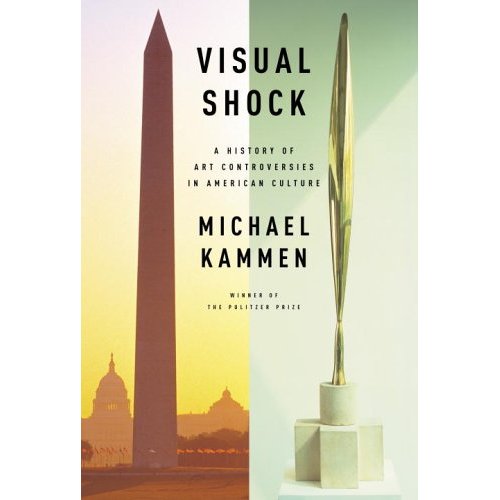
Cornell history professor Michael Kammen will be speaking at the Bookery II this Saturday at 2:30 p.m. He will be discussing issues related to his new book, Visual Shock: A History of Art Controversies in American Culture. Controversial topics include abstract art, nudity and all sorts of salaciousness. MacKenzie Ryan has a brief review in this week's Ithaca Times. She invokes the cover's "seemingly phallic" juxtaposition of Constantin Brancusi's "Bird in Space" with the Washington Monument. That makes two mentions of the great Romanian sculptor in one issue, the other being my own (you've seen it already, I'm sure).

UPDATE (10/29): The above date is correct, but the day of the week is wrong; the talk is Sunday. I'm going to begin a week of traveling by going down to Buffalo and will thus be unable to make it. Sorry for the misinformation.

Labels:

Saturday, July 01, 2006

Summer Reading

The list of books near the bottom of my right sidebar is courtesy LibraryThing, a neat little service for cataloging your bookshelf online. That's a random sample; you can find the (more or less) complete list here. Good, nerdy fun. Makes me want to go out and buy more books too. I sold most of my collection before moving from Boston to upstate New York last fall. Then, of course, I went out and got new ones. So, these aren't necessarily the ones that I've actually read. That's what summertime is for, right?

Labels:

Friday, February 10, 2006

Thinking?

If anybody is interested, the title of my blog is stolen from a book of writings by Paul Klee, who happens to be my favorite artist. I should confess that I haven't read it (it is out of print), but that doesn't lessen its suitability for my purposes. The combination of visual and conceptual rigor implied by the the titlealso manifest in Klee's amazing body of worksets an (impossibly) high standard for my own efforts.

Labels: ,