Wednesday, January 16, 2008

states of the art

Times:
"States of Identity: Real or Imagined" is the State of the Art Gallery's contribution to the upcoming Light in Winter Festival. As usual, it features gallery members weighing in on a loosely-defined theme. This year's theme is "identity." Although this may have served as a jumping-off point for the artists, it doesn't work as much of a guidepost for the viewer.

"States" does have a mood distinct from most SOAG group shows. While carefully observed realism often acts as an anchor, the work here is more experimental. There are a few traditionally figurative paintings scattered about; however, they are not among the strongest works here. In keeping with the hybrid and high-tech character of LiW, mixed-media, collage, and digital imaging rule. The human figure portrayed literally or by analogy is common, as is the natural and built environment presented in unfamiliar and awe-inspiring ways.

Not surprisingly, LiW founder-director Barbara Mink is well-represented. Her three large mixed-media acrylic canvases are standout works, full of her rich geologically-inspired painterly textures. These pieces are new terrain for Mink, as they incorporate collage and portraiture into her signature style. The monochrome faces are printed via photo-transfer. There is some awkwardness in the way they are juxtaposed with the paint. The familiar, intimate forms don't always sit well with the awesome expanses of color.

Black Angels is the most resolved painting in this regard and the best overall. The center is dominated by a black-printed face shown in three-quarter view a portrait of the artist as a young woman. Another artist-head, frontal and less visible, hides in the lower right corner. The piece works so well because the blackness framing the angels is echoed throughout as contour-lines and shadowy patches. Portraiture dissolves into abstract landscape. The background is composed of patches of rich and varied color, particularly turquoise. Angels is named after a string quartet by avant-garde composer George Crumb and incorporates appropriate sheet music.

Grotto is of the same size and proportion and also features a pair of Mink's, this time blending in more. The dark, earthy colors are covered with patches of dark turquoise and thick golden powder. The square shaped Old Country places the face of a white bearded ancestor in a sunken, shrine-like enclosure.

Ethel Vrana is also working with an abstraction inspired by the natural world. The acrylic Event-Particles indeed evokes a microcosm. A loose, branching grid of yellow lines covers a green ground and is itself covered by a cloud of copper. The overall texture is dense and lively with layering, scratches, and air bubbles. A cluster of shiny black droplets hovers near the center. It resembles a living system.

Photographer Jan Kather shows a series of lenticular photographs (the surface is a grid of tiny lenses). Depending on where you stand, you can see either one of two images one astronomical and one earthly or some combination of both. The images are iridescent and mesmerizing. Ausable Eddy Galaxy is particularly compelling. A marble-like maelstrom in black and white is juxtaposed with a pink cloudburst in the darkness of outer space. Central Park Galaxy combines similar astronomy with a blurry nighttime skyline, the park a strip in the foreground.

Carol Ast, long respected for her carefully rendered pastel landscapes, has been trying out new directions recently. Here, she has collages featuring diverse and unexpected combinations of media. Inunnguaq: In the Likeness of a Human: Inuit is on paper. It shows a dark stone monolith rendered in what looks like thick paint, set against a desolate pink pastel expanse. Remarkably enough, the pile is actually made of clay. Ast used regular clay as a top layer with paper clay in the middle acting as a kind of glue (containing as it does both materials). I assume this is a viable technique but the result appears somewhat unwieldy. Still, it is a striking image. Autobiography combines torn paper scraps including fragments of her landscape pastels and bits in silver with dried plant material and energetic pastel strokes.

This Ole House, a digital photograph by David Watkins Jr., shows a decrepit wooden house. The building is at a moderate distance, near the top of the page. Sloping upwards towards it is a swampy landscape filled with barren trees and branches. The dull, wintery colors are punctuated by the green of grass and the red of a brick chimney. The piece hangs in the middle of a row of five prints; each of the others shows an exterior detail of the ruin. Many show corners. It is up to the viewer to construct a whole from the evocative fragments. The borders of the images are uneven which gives them a weathered feel similar to their subject.
A correction: the central image in Black Angels is not Barbara Mink but her daughter (the corner image is Barbara). In Grotto, the top image is the artist.

Labels: , , , , , , ,

Tuesday, June 19, 2007

earthworks

A postcard in the mail today: the esteemed Barbara Mink will be having a solo-show at Aurora, NY's GROVE ("an art and fine furniture gallery"). Entitled "Earthworks", the show will run from June 29 to July 29. There will be a reception on June 30th from 4 to 7 pm.

I've said good things about her work before, but truth be told, I'm a still a bit ambivalent. Her oil paintings
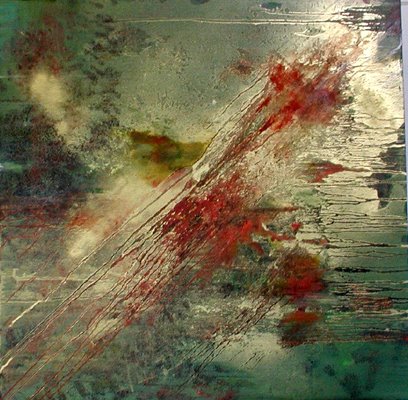
lately some with acrylic mixed inare dense, heavy and romantic. I think my own aesthetic sensibility tends to run a bit cooler. Still, it would be churlish to deny the impact of her best pieces. In some of her recent work, he seems to be moving away landscape allusions and towards a more straightforward fluid post-Pollock abstraction. (Icecaps, the piece above, is something of a hybrid.) I think that this helps.

Labels: ,

Friday, October 20, 2006

more echoes

Barbara Mink, Untitled (2006/8)

I'm trying to catch up with some things that have interested me while on blog hiatus.

*Pop science writer Steven Berlin Johnson writes on the forthcoming computer game Spore, and what he calls "the long zoom". The later is his proposal for a new visual paradigm based on the ability to see and imagine things at vastly different scales--from the global to the microscopic and beyond. I'm no scientist, but this appears extremely relevant to artists, including those working in "traditional media". Johnson develops many of these ideas in his new book, The Ghost Map, a disease thriller.

*Barbara Mink is an Ithaca artist who is grasping her way into this domain. Her half of a two-person show back in August contained rich, painterly abstractions that move away from her earlier, more recognizably landscape inspired work. An included statement cited the influences of natural diasters and Hubble space telescope imagery. (Regretably, I don't have a copy of the statement right now; if Barbara or anybody else wants to send it to me, I'll consider posting it here.) I think the work isn't quite living up to the concept yet; nevetheless, they are beautiful paintings. I review an earlier show of hers here.

*Other artists working within "the long zoom" occupy a disproportionate number of slots under the heading "Artists" in my sidebar. They are representatives of what I consider to be one of the most promising developments in recent art. Check them out.

*Natasha Pickowicz (my boss!) has a short essay on a recent local performance by (the) Small Sails. I was there myself, and was mesmerized by their spacey, electro-acoustic sounds and backing video projections. The theatre (one of Cornell's cinematheques) was almost completely dark; at times I would forget that there were actual live musicians performing onstage. I still don't know what the performers look like.

*Local artist Steve Poleskie's blog is among my favorites. He has done everything from realistic portraiture to "aerial theatre". In the early to mid sixties, he lived in New York City, where he founded and ran the screenprinting studio Chiron Press. He worked there with a broad cross-section of the New York artworld. Needless to say, he knows some interesting characters. He came to Ithaca to teach at Cornell in 1968 and has mostly lived here since. He also has a new historical novel
, The Balloonist, to be published soon. His blog revolves around his long and fascinating life, as well as new projects of his.

*Warren Craghead's a map's little spell is an innovative combination of hand drawing, collage, and web interactivity. It explores some of the weirder aspects of the familiar suburban landscape. It is strangely reminiscent of the "computer games" I used to write as a child on some primitive Mac.

*I've been enjoying Matt Madden's sweet, playful meta-comic 99 Ways to Tell a Story: Exercises in Style, which you can preview here. Based on the format of French writer Raymond Queneau's own classic Exercises (also highly recommended), he repeats nearly one-hundred times the banal incident of a man getting up from his work to go to the refrigerator. Each reiteration is done a different way. Formal elements are rearranged and various popular comics genres (daily strip, fantasy, horror, superhero, etc.) are pastisched. Its tremendously entertaining.

Labels: , ,

Wednesday, April 12, 2006

Writing Pedigree Zero

In talking with Barbara Mink at her opening last Monday, the subject of my art blog came up. (Also blogging more generally, but who cares about that?) Mink likes my writing, comparing "The Thinking Eye" favorably to the general glut of online journaling. Somehow during this discussion, the notion of "pedigree" (her term) came up.

I'd like to make it clear, if it isn't already, that I don't have much of one. I have an undergraduate degree in studio art from a credible institution, which is about it. I've never written about art for money in my life, (although with any luck this will change soon). I don't have a degree in art history or art theory or anything like that. That may change as well, but not soon at all. I've also never formally studied writing beyond the usual college freshman level.

It may be worth pointing out that Mink herself lacks much of a pedigree when it comes to painting, at least according to this sketch of a resume. On the other hand, her formal qualifications as writer are considerable. Among other things, she lectures in management communication at Cornell's Johnson Graduate School of Management. Many (perhaps most) of the pe
ople at the opening were her students or collegues. She has also been involved in a wide variety of local politics and other social organizing. More interesting for me at least is her job as director of Ithaca's yearly "Light in Winter" festival. (Last January's festival included the lovely Laurie Anderson.)

So anyway, I was wondering about the relative value and merits of a (strong) pedigree in the visual arts and writing (critical, journalistic, etc.). How do we know when to take artists seriously if they don't have a BFA or MFA? If these credentials are unnecessary, what (if anything) is their significance? On the other side of the fence, what is the value of "uncredentialed" writing in this age of specialization and expertise? The internet, and blogging in particular (I didn't want to bring this up, sorry) seems to be a hotspring for the do it yourself ethos. I think that this is largely a good thing; (how) do we get this across to ivory tower communicators? Finally, how symmetrical are the two sides of my metaphorical fence? Is writing inherantly more formal or technical or serious than painting? Or is it just a matter of entrenched institutional habit?

Labels: , ,

Monday, April 10, 2006

Mink

"Marsh"

I attended an opening for the local artist Barbara Mink earlier tonight at the Willard Straight Hall Art Gallery. Mink showed twelve pieces from a series of layered, richly textured, drippy oils she calls "Interior Landscapes". While these paintings have titles like "Delta" and "Estuary", this literalness often seems a bit forced. Which isn't to say that they don't evoke natural landscape. They do. They're also reminiscent of Michael Mazur's paintings. You can see more of these interior exteriors on her website.

Unfortunately, the gallery space was too dimly lit to see the work clearly. The austere neo-Gothic interior was however, in a way, a great place to see these paintings insofar as it offset their lush romanticism with something sterner. I saw similar (indeed I believe much of the same) work by Mink last fall at downtown Ithaca's Sola Gallery and liked it quite a bit a less. In part, I think the work is simply growing on me. But I also think I was put off by their presentation there as decorative art, beautiful objects for upper middle class interiors (click on the link above and you'll get the idea). Here they remind me of stained glass windows (albeit without backlighting).

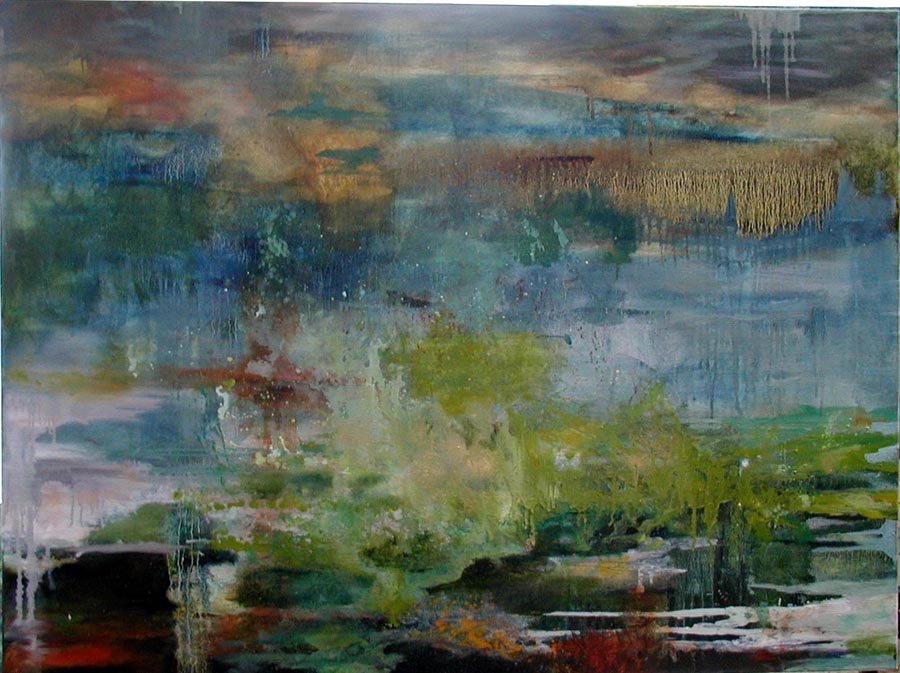
My favorite piece, "Marsh" (see above), felt the most resolved in its balance of different colors and textures. With most of the pieces, the details were more interesting than the wholes. They're often dominated by a single overall color range: green, or in the case of "Desert Sea", yellow-orange. Others introduce fiery red, giving them a dissonant quality which I find over-dramatic. This is most interesting (not necessarily successful) in "Portal" which is also notable for its gridded structure. Red makes an appearance in "Marsh", but the effect is more muted (though not as much as the reproduction would lead you to believe.)

I mentioned Mink's name in a previous post, citing her as one of the few local artists doing innovative, alternative landscape work. I want to promote that. Given my mixed feelings about Mink's actual pieces, I may have been a little bit too generous here. Still, these are pleasurable paintings.

Labels: ,

Wednesday, March 01, 2006

Some Thoughts on Landscape

As Nancy Geyer points out in this thoughtful comment, Ithaca is indeed "inundated with uninspired landscape paintings"; she also points to a similar problem with with landscape photography. Works—often not very well done—do look as if they "could have been painted centuries ago". Since I agree that this an issue (and not just here, I've seen similar work living in Boston), let me offer a few ideas, not all of them specific to the problem of landscape. Also, these may be slanted more towards painting and drawing (my own focus as an artist), than photography or other media. The point is to suggest alternatives to cliche.

*Artists should be aware of art history. This means both breadth and depth. They should look at what artists from a wide range of times and places have done, and have some sense of how it all interrelates. However, it is also important to look closer at things
—artists, styles, movements, techniques—that you find particularly interesting or useful. This is important for everyone, but perhaps particularly for those who see themselves as traditionalists. Being a traditionalist without (fully) understanding the tradition in question is a big problem, often leading to bodies of work that are confused and directionless (and boring).

*Artists should be familiar with a wide range of contemporary art. Obviously, this doesn't mean simply looking to jump on whatever the latest bandwagon is, nor does it mean uncritical approval. It does mean being aware of what your options are. It generally doesn't make much sense to just pick a date and say that nothing that developed after that is any good (unless you really know what you're talking about, which is rare). Travel, read, go to school
—do what you have to do.

*Look at the connection between landscape and abstraction. Many if not most of the early abstractionists (Mondrian, Kandinsky, Klee, O'Keefe, many others) developed this direction out of earlier work in landscape. You can see precursors of this approach in earlier landscape painting
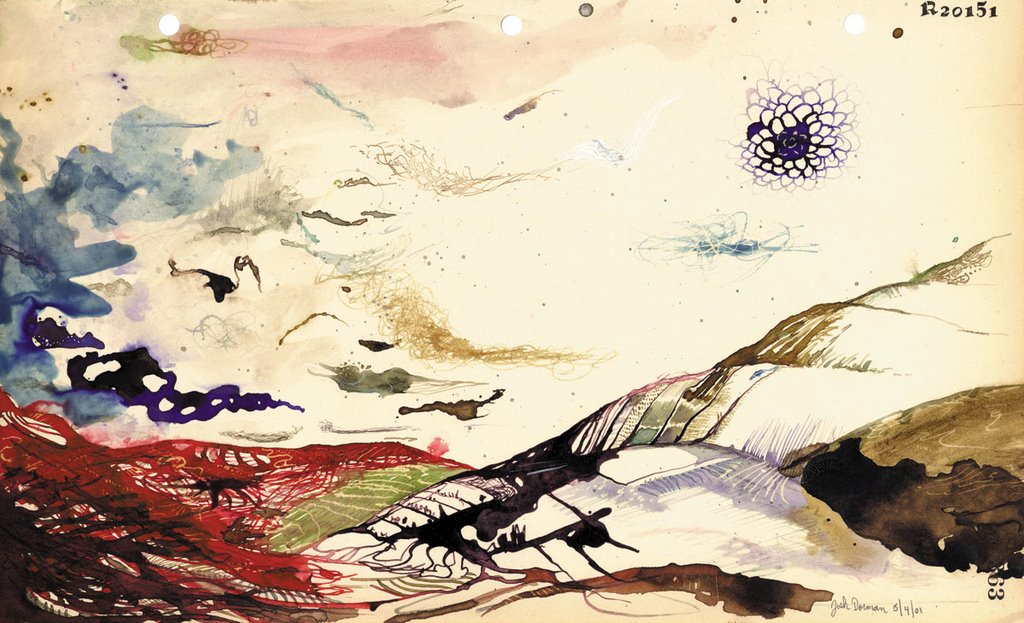
—for example the work of J.M.W. Turner. Landscape can take us away from our usual sense of scale, away from the world of familiar people and objects. It can be macroscopic or microscopic. It can incorporate distortions, other ways of seeing and depicting. NYC artist Josh Dorman (more pictures here and here) does all of this ingeniously. Also worth paying attention to are locals Barbara Mink and (more interestingly) Barbara Page.

*Landscape doesn't have to be pastoral. Cataclysm and chaos are a big part of the natural world. Likewise, violence is central to our culture (and others as well). Local printmaker Craig Mains (see my last post) is a good example, as is (my former teacher) painter Gerry Bergstein (more information and pictures here and here), sculptor Heide Fasnacht, as well as (again) Turner.

*Landscape isn't just natural landscape. It should go without saying that we are constantly surrounded by man-made things, even in the countryside. The interweaving of the natural and the artificial (even to the point where these categories can become blurred) is a particularly interesting subject.

I'm not a art teacher, so I don't have any clear ideas about what should be done in this field. Although I do think traditional techniques and approaches should be taught, I don't think its a good idea to simply pretend that we're living in the nineteenth century.

Labels: , , , ,