Monday, January 21, 2008

rural research


I went down to Elmira last Saturday to visit the Rural Research Laboratories for the first time. RRL has recently taken over a red-brick carriage house located behind the Arnot Art Museum (which I have yet to visit). The grassroots organization houses artists' studios and communal workspaces as well as three ground-floor exhibition spaces. They also seem to have an busy program of poetry readings and folk concerts. Tom Oberg is the founder.

The place was clean and well-lit, not the kind of bohemian filth-hole I half-expected of an "alternative" arts venue. A nice touch: they had an exit-style sign reading "KURT" in homage to a recently deceased comic-absurdist novelist who attended Cornell.

Saturday afternoon was a closing reception for three shows. These included a series of not-really-monochrome paintings by Ed Malina and one of Steve Salsburg's documentary photographs. (There was also a hallway video-projection by Chris Keck and Steven Kistler, of melting icebergs, which I got an insufficient look at -- sorry.) Both were impressive.

Malina's paintings are single-colored in front, with textures that are variously lumpy or smooth. The surfaces are fetishistic but the effect of looking at several dulls this appeal. (Although there was at least one I really liked: a dark purple-brown one with a grid of round lumps reminiscent of Eva Hesse's Schema.) The real action takes place along the edges, where you can see solidified dripping cascades of paint in different colors. These reveal the layering and the labor behind the perfect surfaces and call attention to the often frame-like supports. My feelings were mixed.

Salsburg's startling gelatin-silver prints come from a single roll of film shot in 1970, when he was a flight-surgeon in Vietnam
. They show the inmates of a leper colony, along with medical and military personnel there to help them. They betray a sharp eye and an urge to depict his often deformed subjects (many of them children) with both dignity and honesty. You can read more about them and him here (.pdf).

I got to meet RRL associate Jan Kather, who has a series of fine lenticular photographs up at the State of the Art (see my previous post for a review). She teaches photography and video art at Elmira College, and sometimes at Cornell as well. She was very kind and I look forward to seeing more of her work.

Also, I rode down with Buzz Spector and had an interesting conversation with him, although I won't recount it here.

Labels: , , ,

Saturday, December 08, 2007

happening

I attended the downtown Gallery Night openings yesterday. Things seemed particularly festive and well-attended, no doubt due in part to the shopping season. Special events may have also played a part. NYC painter-printmaker Maddy Rosenberg was having a launch party for her new sculptural book, Dystopia at the Ink Shop. It is being published by the Shop's own Olive Branch Press and features black and white linocut images of architectural fantasia. You can see it on her website although I can't link directly to it. It looks good.

The Art Bar Gallery is open every year for about a month during the holiday season. Their gimmick is to sell fine Swiss chocolate bars, each with a collectible card featuring the work of one of the gallery artists. (Buzz Spector, featured a few years back, suggests the inclusion of stats.) As in past years, the artists are from both Ithaca and all around. The concept is fun and the art
—while generally a mixed-bag—is at least something different. And they had champagne and chocolate cake at the opening.

A common characteristic was for the December shows to be markets rather than carefully assembled productions. Which is essentially what many of them are anyway, so perhaps its better to drop the more elevated pretenses.

Next Tuesday evening, I'll be driving down to Elmira (NY) with my Times colleague Wylie Schwartz to check out the Rural Research Labs, an artist's collective and exhibitions space. They're holding a press reception, though who knows who else will show up.

In other news, I will be spending about two weeks with my brother and motley housemates in San Francisco. I'll be flying out from Syracuse on the 14th. I'm looking forward to exploring the city, to which I've never been. The fifty five degree weather should also be nice.

Art-wise, it appears that SFMOMA is showing Joseph Cornell: Navigating The Imagination, which I got to see last winter in D.C.. The show was lovely but also too much to see in one visit, especially given the small-scale intricacy of Cornell's boxes. And they have a little Klee drawings show! At least two people I know personally are showing in the galleries. Kumi Korf's quiet calligraphic abstract prints are up at Chandler Fine Art and Framing. Jamie Vasta (a SF local I know from art school) is showing carefully crafted glitter paintings at Patricia Sweetow.

With any luck, I'll be able to blog from the West Coast. Otherwise, expect a flurry of posts around the beginning of next year.

Labels: , ,

Wednesday, November 28, 2007

d.c. diary

I spent the recent holiday with relatives in some desolate D.C. suburb, which honestly was not so much fun. But I did get the chance to consume a couple stray bits of culture. Some brief notes then.

First, and most significantly, I saw Morris Louis Now, a small retrospective, at the Hirschhorn. I have nothing original or intellectual to say about the man or his work right now. (I have too many other writing projects at the moment. Also, I'm just at a loss for words.) But I will say that these stained acrylic on canvas abstractions are among the most gorgeous things that I've seen this year. Their combination of cool analytic order and deeply sensuous color is intoxicating. I wish I could go back. I particularly like the wide empty spaces of his late late work (bare canvas!).

My favorites might be the so-called "unfurled" series, in which the artist dripped diagonal rivers of thinned (but saturated) color from the side edges. Here is an example. It's an intriguing compositional device; I'm not sure where else in the history of art it can be found. In Chinese painting, perhaps?

From the museum site linked to above:
The exhibition presents major paintings dating from the early 1950s until his death in late 1962, the years Louis developed an innovative method of painting by staining his unprimed canvases with thinned washes of acrylic pigments. The artist, who was born in Baltimore, Maryland, in 1912, studied at the Maryland Institute of Fine and Applied Arts. As a young man he painted in a realist manner; only in his forties did he find his signature style. Even in cramped quarters in Washington D.C., Louis was able to make large paintings, achieving an exuberant, lyrical celebration of colors hovering in white space. Louis became an inspirational figure for other artists in the Color Field movement in the 1960s, notably Kenneth Noland and Helen Frankenthaler.
According to the same source, Louis has not had a retro since 1986 (when I was a kid), which is shocking. Needless to say, I am unable to compare this one with others. But the size and selection felt perfect to me, given that a little of his work goes such a long way.

And I read a short novel: Mark Dunn's fun, wordplay-laden Ella Minnow Pea. The book is written as series of letters, most of them between two teenage girl cousins: Ella and Tassie. The events described therein take place on Nollop, a fictional island off the South Carolina coast. The island is named after Nevin Nollop, the author (also fictional) of the sentence "the quick brown fox jumps over the lazy dog," which is a pangram, containing all the letters of the alphabet. As evinced by the exchanged epistles, with their alliteration and ornate, precious usage, the islanders have an unusual fondness for language. (This is entertaining some times and annoying at others.)

Nevin is worshiped as a godlike figure, and when letters start falling off of his memorial statue
—off of the pangram—they are successively banned by the superstitious, tyrannical Council. First time offenders get off with a mere scolding, but a second violation brings a choice of flogging or the stockade. A third time brings expulsion from the would-be linguistic utopia. The novel tells of the progressive devolution of the society as a result of communicative breakdown and the departure of people (voluntarily or otherwise). The letters—with some exceptions—follow the law lipogrammatically, with humorous results. Later sections are clouded with increasingly evasive, absurd substitutions and mispellings.

Ella must demythologize Mr. Nollop in order to discredit the theocracy. To this end, she endevours to find another pangrammatic sentence with 32 or fewer letters. She is assisted in this task by others, including the renegade councilman Rederick Lyttle (hah) and Stateside scholar Nate Warren (with the predictable love story between Tassie and the latter). I'm sure you can guess how things turn out.

Ella is lighthearted and light-weight as a satire of theocracy and censorship. The wordplay, and the writing more generally, was however, a joy to read.

Labels: , , ,

Friday, March 16, 2007

travel, abstraction, links

Sorry things have been so slow around here. But this blog is almost always best when I'm actually looking at art that really engages me and there hasn't been so much of that going around here. More generalized ponderings need to follow from that, usually. I have pretty broad taste and can appreciate a lot of things on a rational level, but that doesn't necessarily mean that I'm jumping out of my seat. Also, reviewing often mediocre shows for the paper—currently near-weekly—this whole art-writing business begins to look just a little bit mre like actual work, and a little bit less like the uncoerced, unalienated activity I like to imagine that I started with. Not that I'm complaining really; I enjoy what I do.

Anyways, its a pleasure to report that I'll be spending the majority of next week hanging out in the Boston area, with art-viewing at the top of my agenda. I'll be writing up "Big Bang! Abstract Painting for the 21st Century"
—currently up at the DeCordova in Lincoln—for Big Red & Shiny. Silly, hyperbolic title aside, it looks like a promising show. Franklin Einspruch of Artblog.net has an ably written and cautiously enthusiastic review here. I'll reserve full judgment until I've seen it in person, of course. Nevertheless, much of the work appears to embody what I find most encouraging in the art of today: a combination of formal daring and the willingness to reconcile abstraction with the concerns of everyday life in the modern world. That probably sounds both vague and pretentious; elaborations to follow soon.

On a similar note, I'd like to draw your attention to some related proclamations and discussions online and beyond. Madinkbeard
—a new addition to my sidebar and an all-around enlightening-read—has posts linking the abstract painters Cy Twombly and Pierre Alechinsky to comics and narrative. Intriguing images, especially in the latter case. Birgit Zipser has an interesting, if wrongheaded, post on abstraction and mental illness today at Art & Perception. See the following discussion for an ongoing debate on art versus science, abstraction versus representation, and nature versus nurture. Not directly related to abstraction, but still worthwhile: Stacy Oborn on defining personal aesthetic sensibility. Finally, and turning back to the real world, Linda-Price Sneddon and Mark Schoening have an ongoing experimental project, inFlux, which you can read about here, or go see at Boston's Laconia Gallery. (Yes, most of the names dropped above are acquaintances of mine.)

Anyways, I hope to be blogging every other day or so from Boston, probably starting on Wednesday, and hopefully sustaining me for a while after my return.

UPDATE (3/17): There has been a change of plans, as my traveling companion apparently has come down with a bad case of jury duty. I'll be going down on Thursday morning instead. Perhaps I can arrange to stay beyond Sunday
—I'd certainly like to.

Labels: , ,

Tuesday, November 07, 2006

travel diary: part one


David Byrne, Doggie Chew Toy, 2006


Robert Rauschenberg, Baby Venice (Scenarios), 2005


As I've been saying all along, I spent most of last week on the road, and in Buffalo, New York, and Boston. Here is a record of what I did, written afterwards as an aid to my slippery memory. I'll be putting this up in installments, perhaps two or three.

I made a day trip to Buffalo on Sunday, accompanied by my old man and two old family friends. The weather was sunny and fairly warm, but you could see felled trees and other signs from an earlier snowstorm. After eating some excellent Buffalo wings (and some other food, which was not so hot) at the legendary Anchor Bar, we headed straight to the Albright-Knox Gallery.

There I saw the stylish and fascinating, if indifferently installed and perhaps conceptually confused (and certainly confusing, for the uninitiated) Andrea Zittel survey Critic
al Space. Zittel constructs little architectural vignettes, with a focus on interior spaces. These combine playful imagination with a generally not too heavy-handed social critique. Several small gouaches got me thinking about how I often use the familiar medium of paintings as a vehicle for understanding the big scary world of conceptual art.

Needless to say, I also got to see some amazing work from their permanent collection. The main emphasis is on American postwar modernism (through perhaps 1970 or so). My favorite piece was Arshile Gorky's The Liver is the Cock's Comb, which as another gallery visitor pointed out, has something of a Disneyesque feel. For those completely unfamiliar with it: the combination of calligraphic black lines dissolving (into) animated color forms is incredible. Classic paintings by Jasper Johns, Larry Poons, Jackson Pollock and Richard Diebenkorn were among the other highlights. I also liked Random Fire, by a younger (but unfortunately deceased) artist, Moira Dryer. A wooden panel covered with thin green streaks and punctured by holes, was accompanied by a music stand, on which sat a green target covered panel. It was a playful response to some of the high-Modernist masterpieces that surrounded it.


After a three or so hour drive back, I spent the rest of the evening and a quiet Monday, in Ithaca. On Tuesday morning, I woke up a little earlier than usual to catch a 1:35 a.m ShortLine bus from Collegetown in Ithaca to New York City. Contrary to the schedule posted on the Internet, however, there was in fact no bus leaving at the time. Around 2:00, I learned--from a bus driver arriving in Ithaca from NYC-- that my bus in fact had passed through an hour earlier. He told me that the same thing had happened the night before; for some reason he had neglected to notify anybody. I did get him to place a call, but his speech on the phone (it might have been a radio, actually) and to me and a fellow disgruntled traveller was soft and indecipherable. (This misinformation--assuming that that is in fact what it is--is still posted on their website as of this writing.) Anyway, after much drowsy pacing around, and a tasty if wholly inauthentic Greek meal in an all-night diner downtown (virtually impossible to find in Boston, last time I checked), I managed to catch the 4:15 bus and fell quickly asleep.

Arriving at the Port Authority dungeon at around 10 in the morning, I was not as bleary-eyed as I had feared. After eating the soggy remains of my diner cuisine, washed down with mouth-scalding coffee, I got my bearings (well, sort of) and walked out in search of art. I ended up, shortly afternoon, in a 57th Street gallery building, home to Pace/MacGill and PaceWildenstein. At the former was a series of cleverly re-imagined chairs by artist-musician David Byrne. These were built from unusual materials and took unusual forms. My favorite was a midget scaled love-seat, built out of molecular models. Also present were a number of related drawings and sketches, most interestingly a series embroidered on bits of upholstery (these being reminiscent of some of the work of Sigmar Polke). The oddball materialism of Tom Friedman is another point of reference for this show.

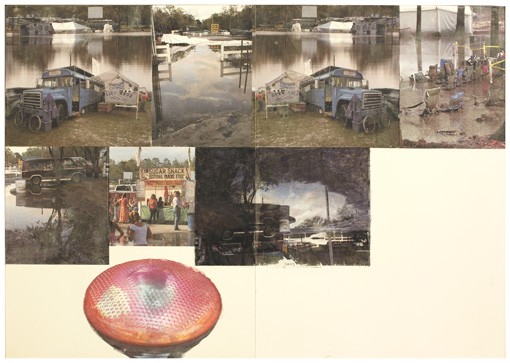
At the Wild P(l)ace, was a series of stacked shows, most prominently Robert Rauschenberg: Scenarios and the Ancient Incident. A series of nine recent "paintings"--actually done through some kind of photo-transfer process-each juxtapose a series of snapshot-like photos in a deceptively casual-looking manner. Each piece in the series depicts an iconic American scene; these range from the grittily urban to the quaintly rural. Climbing a rickety spiral straircase, I made it to their second space. While a series of Robert Mangold prints seemed to be the central attraction, I was more compelled by a small side room showing of Post-Impressionist and Picasso prints, published by the great Ambrose Vollard. The pieces in the room tie into a show at the Met, which I missed this time around. My favorites were two interior scenes from a well-known series by Edouard Vuillard (here and here). The colors, the flattened but still dynamic perspective, and the psychological dynamic of the two figures in III are exquisite. The galleries were being toured by a group of elderly Jewish ladies.

On 41st Street, I saw one of my anticipated highlights, Personal Geographies: Contemporary Artists Make Maps. The gallery is part of Hunter College. The school building, situated across the street from a large dirt lot under construction, looked bleak and unpromising from the outside. Inside were security guards, a metal detector, and line of students. Since the gallery-sitter--who was supposed to show up at 1:00--was missing in action, somebody else let me in and I had the gallery to myself for a while. It was made up of several cavernous spaces, forming something of a maze (appropriately, a color-coded map was included in the catalog). The cartographically themed work in the show went from the schematic and conceptual to the richly painterly. Although I am willing to embrace both extremes, my eye tends to be drawn to the latter more easily. This was especially true Tuesday, due to a lack of time (I'd like to go back to look at the stuff I only glanced at, but I fear this will not happen).

The best works in this vein were Joshua Dorman's paintings on old maps, affixed to panels. A long-time favorite of mine, Dorman alters these relics in ways that both echo and deviate wildly from the originals. Among the myriad modificaions and additions were painterly re-interpretations of rivers, roads, and other passageways, imaginary buildings and cities, (sometimes exotic) flora and fauna, and the assorted detritus of industrial and consumer society. He tries to use almost every kind of perspective in the book, sometimes all at once. One large, multi-paneled piece was ornate, even by Dorman's standards. One imagines that he felt there was too much there, because the piece features a large, empty white triange clearly obscuring yet more of his frenzied imaginings. Tiny Lives, Beantown, a take-off on Boston suburbia, was refreshingly straightforward. Here, he limited his intervention to delicately painted fields of pink, black, and light brown.

Another favorite of mine was a wall relief installation by Janice Caswell: a dense network, mapped with colored paper squares and dots, an eclectic assortment of push pins, and a dense web of thread and wire. Several colorful yet schematic drawings accompanied it. Also of particular interest were paintings and sculptures by Jennifer Dalton, Joyce Kozloff, Ward Shelley, and Danielle Tegeder.

A few artists presented works either not to my taste, or seemingly out of place in the show. Kim Jones' pencil maps of imagined battlefields, while interesting, seemed overly juvenile (without the skill or irony found in the conceptually related work of Kozloff). Abbey Leigh's freakish animal-vegetable hybrid drawings were appealing, but stretched the mapping idea a bit too far. "Body Maps", by the Bambanani Women's Group of South Africa were too rough and "primitive" in style and concept for my taste.

After leaving the gallery and once again getting my bearings, I hopped on a subway headed downtown, emerging a bit later in Chinatown. I found the kiosk and purchased $15 tickets for the Fung Wah bus to Boston. (Fung Wah is one of several companies providing inexpensive Chinatown to Chinatown travel. The buses are used mostly by Chinese Americans, but are also frequented by college students, hipsters, and other unsavory types.) Walking around the block, I found a fast food Chinese noodle soup place, where I got a decent made to order meal with meat and vegetables for three dollars. Being cheap paid off pretty well last week, I would say. The bus departed on-time at 4:00 p.m., and it got to Boston without anything going wrong, which is much more than I can say about ShortLine (more on them later).

Labels: , , ,

Friday, November 03, 2006

holding on

I've been traveling over the last week, hence the lack of posts. I've been in Buffalo, New York and Boston. Some art-related highlights include visiting the Albright-Knox (both their fine permanent collection and their Andrea Zittlel survey), seeing the Bergstein show at Boston's Gallery NAGA (and talking to Bergstein himself), and seeing Personal Geographies in NYC. And yes, I've seen and done some things here in Ithaca as well. I want to cover everything, so expect a deluge of posting to begin here shortly. UPDATE (11/07): My review of the Bergstein show appeared in Big Red & Shiny yesterday.

Labels:

Tuesday, May 23, 2006

Mixed Nuts

The following paragraphs don't relate to each other too well. Many apologies.

I don't normally like to discuss my personal life here, except to the extent that it enters into the world of art. Likewise, I realize that it's painfully cliche to apologize for not updating your blog more often. I'd hate to do that. But I do want to say that I've been suffering from chronic insomnia, which makes it difficult to to write, think, experience art or to do much of anything else. If anybody has any unworkable folk remedies, by all means let me know. The more colorful (and ridculous), the better.

On a slightly less self indulgent note, if I'm not feeling too lousy, I'd like to follow-through on my long simmering plans to visit Boston later to this week. Among other things, I'd like to see (and write about) some art. Things that seem of particular interest include the Decordova Annual and Linda Price-Sneddon's "The Trees Have No Tongues", currently up at the Hallspace gallery. I like Linda's kind of work and don't get to see any around here. Wandering around the MFA would be nice, for old times sake. Saturday, Mobius is organizing a day of performance art and other oddities in front of city hall. Finally, Eva Hesse in NYC, if I can make it there. She's neat. If anybody has any tips, let me know.

I spent a few hours this afternoon at the Johnson, most of them with Willie Cole's travelling "Afterburn", which features work made in the past decade. (The title is a joking reference to his signature motif, the iron.) You might have read about it in the last Art in America. I took notes and will write substantially about it, although probably not in the next few days. I'll give you some idea of what I'm thinking. I want to discuss the work throught the filter of two concepts: primitivism and pastiche. I touched on the former in my last post, conveying my dissatisfaction with work which (naively, I think), attempts to recreate an idealized "primitive" condition within the modern world. Cole's work escapes this trap. My working hypothesis is that it does so by being contemporary (in its references and materials) while maintaining an anthropomorphic, animistic quality which links it to the past. As for the latter, it is difficult to write about his work without citing his numerous quotations from modern and contemporary art. And while recognzing these is part of the pleasure of his work, its important to go beyond simple name-dropping. Anyway, all of this is less tediously academic than it sounds, so of course I'll discuss individual pieces. The show is a lot of fun!

Labels: , ,

Thursday, February 23, 2006

Art in NYC

I spent most of Monday and Tuesday in New York City, walking around Manhattan, and looking at an astonishing variety of art.

On Monday afternoon, I went to MoMA, which seemed insanely crowded. I didn't have the time to see any of the big special exhibitions, but I did see a neat little show of etchings, which contained likeable works by artists as diverse as Sol LeWitt and James Ensor (including this piece). There were also intricate etchings by the great James Siena, who lectures at Cornell on March 7th. The next day, I went to the Met, where I saw the incredible retrospective of Rauschenberg combines (more on that later).

Tuesday, I also had a few hours of desultory gallery-hopping in Chelsea, which felt cold
(both literally and figuratively). I was disappointed by most of what I saw, more so than usual. Here are few highlights, reflecting my own idiosyncratic tastes and responses rather than any kind of systematic judgment.

Lucky de Bellevue's colorful chenille (pipe-cleaner) mounds filled the main space at Feature Inc. These web-like pieces were either suspended from the ceiling and/or walls, or attached to various found-object bases (one loosely figurative work was resting on a cane). He has this to say about his art:
I think this humorous conflict is implicit in my work: the beautiful/grotesque, the abject glamour, the materials, and sometimes the titles. When I first started doing this type of work, there was a bit of a "fuck you" attitude in my mind about it and, although there are still elements of irony I am much more sincere about it moving dangerously close to total sincerity.
Roxy Paine's show of sculptures at the Jam
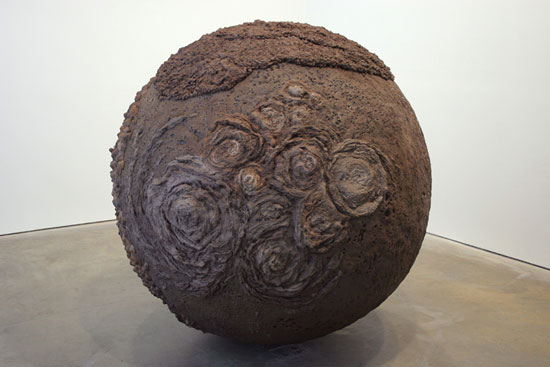
es Cohan Gallery, although (as usual) diverse in approach, was brought together by his interest in blurring the distinction between art and nature. Although the centerpiece of the show was probably the life-like Weed Choked Garden, my favorite piece was the strange, fungal Bad Planet (see above, also here for a detail). Also notable was Erosion Machine, a laptop controlled blasting device, gradually working on this landscape. Unfortunately, it wasn't running while I was in the gallery.

Here is a fairly unsympathetic review of the show
—the pieces "offer a kind of Madame Tussaud's experience for the artworld". That might be true if Paine did just the hyperrealistic pieces (he has also done mushrooms). However, seen in the context of his other work, it would be misguided to simply stand back in awe of their verisimilitude (although this is part of their appeal). In particular, this is true because his machine-made abstractions also have a life-like, "natural" quality to them. So, I think you need to reconsider the dualism of realism vs. abstraction, as well as that of art vs. nature. None of this is "conceptually neat" at all, and most of it is fun to look at too.

Thomas Nozkowski's small, stylistically varied abstract paintings were up at Max Protech. I thought the hanging was sparser than it needed to be
—his work benefits from clustering. The pieces were more or less interesting. I particularly liked his Untitled 8-67, with its wispy blue background and its accumulation of candy colored tounge forms. Here is a recent interview.

Labels: